Advertisements
Advertisements
प्रश्न
Find the missing values.
| Base | Height | Area |
| 18 cm | 5 cm |
Advertisements
उत्तर
Given: Base 6 = 18 cm
Height h = 5 cm
Area of the parallelogram = b × h sq.units
= 18 × 5 cm2
= 90 cm2
Tabulating the results, we get
| Base | Height | Area |
| 18 cm | 5 cm | 90 cm2 |
APPEARS IN
संबंधित प्रश्न
The adjacent sides of a parallelogram are 21 cm and 28 cm. If it's one diagonal is 35 cm; find the area of the parallelogram.
Find the missing values.
| Base | Height | Area |
| 8 cm | 56 sq.m |
A square and a parallelogram have the same area. If the side of the square is 48 m and the height of the parallelogram is 18 m. Find the length of the base of the parallelogram
In a parallelogram PQRS (See the diagram) PM and PN are the heights corresponding to the sides QR and RS respectively. If the area of the parallelogram is 900 sq.cm and the length of PM and PN are 20 cm and 36 cm respectively, find the length of the sides QR and SR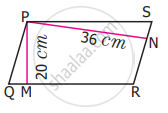
Find the area of the parallelogram ABCD if AC is 24 cm and BE = DF = 8 cm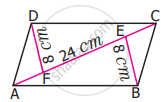
The area of the parallelogram ABCD is 1470 sq.cm. If AB = 49 cm and AD = 35 cm then, find the height, DF and BE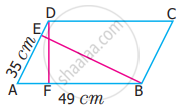
Find the height of the parallelogram whose base is four times the height and whose area is 576 sq.cm
If the sides of a parallelogram are increased to twice its original lengths, how much will the perimeter of the new parallelogram?
All parallelograms having equal areas have same perimeters.
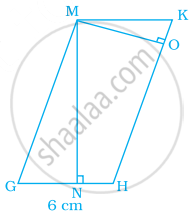
Altitudes MN and MO of parallelogram MGHK are 8 cm and 4 cm long respectively (see figure). One side GH is 6 cm long. Find the perimeter of MGHK.