Advertisements
Advertisements
प्रश्न
If the sides of a parallelogram are increased to twice its original lengths, how much will the perimeter of the new parallelogram?
पर्याय
1.5 times
2 times
3 times
4 times
Advertisements
उत्तर
2 times
Explanation:
Let the length and breadth of the parallelogram be l and b, respectively.
Then, perimeter = 2(1 + b) ...[∵ Perimeter of parallelogram = 2 × (length + breadth)]
If both sides are increased twice, then new length and breadth will be 21 and 2b, respectively.
Now, new perimeter = 2(21 + 2b) = 2 × 2(l + b) = 2 times of original perimeter.
Hence, the perimeter of parallelogram will be increased 2 times.
APPEARS IN
संबंधित प्रश्न
Find the area of the following parallelogram:
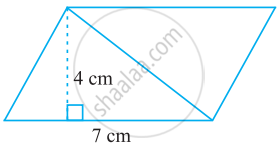
Find the area of the following parallelogram:
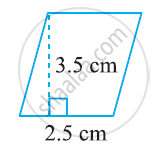
Find the area of the following parallelogram:
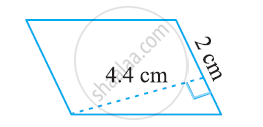
The adjacent sides of a parallelogram are 21 cm and 28 cm. If it's one diagonal is 35 cm; find the area of the parallelogram.
In a parallelogram PQRS (See the diagram) PM and PN are the heights corresponding to the sides QR and RS respectively. If the area of the parallelogram is 900 sq.cm and the length of PM and PN are 20 cm and 36 cm respectively, find the length of the sides QR and SR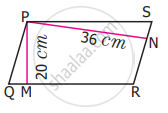
If the base and height of a parallelogram are in the ratio 7 : 3 and the height is 45 cm, then fixed the area of the parallelogram
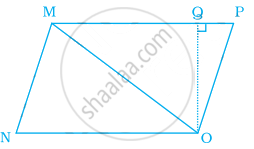
Ratio of area of ∆MNO to the area of parallelogram MNOP in the same figure is ______.
In the following figure, area of parallelogram BCEF is ________ cm2 where ACDF is a rectangle.

In the following figure, area of ∆AFB is equal to the area of parallelogram ABCD. If altitude EF is 16 cm long, find the altitude of the parallelogram to the base AB of length 10 cm. What is the area of ∆DAO, where O is the midpoint of DC?

ABCD is a parallelogram in which AE is perpendicular to CD (see figure). Also AC = 5 cm, DE = 4 cm and area of ΔAED = 6 cm2. Find the perimeter and area of ABCD.
