Advertisements
Advertisements
प्रश्न
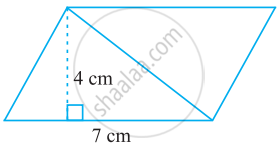
Find the area of the following parallelogram:
Advertisements
उत्तर
Area of parallelogram = Base × Height
Height = 4 cm
Base = 7 cm
Area of parallelogram = 7 × 4
= 28 cm2
संबंधित प्रश्न
A parallelogram has sides of 15 cm and 12 cm; if the distance between the 15 cm sides is 6 cm; find the distance between 12 cm sides.
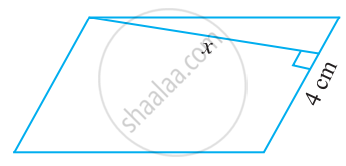
Find the height ‘x’ if the area of the parallelogram is 24 cm2 and the base is 4 cm.
A ground is in the shape of parallelogram. The height of the parallelogram is 14 metres and the corresponding base is 8 metres longer than its height. Find the cost of levelling the ground at the rate of ₹ 15 per sq.m
The area of parallelogram whose base 10 m and height 7 m is
An agricultural field is in the form of a parallelogram, whose area is 68.75 sq.hm. The distance between the parallel sides is 6.25 cm. Find the length of the base
A square and a parallelogram have the same area. If the side of the square is 48 m and the height of the parallelogram is 18 m. Find the length of the base of the parallelogram
If the base and height of a parallelogram are in the ratio 7 : 3 and the height is 45 cm, then fixed the area of the parallelogram
Find the height of the parallelogram whose base is four times the height and whose area is 576 sq.cm
In the following figure, area of ∆AFB is equal to the area of parallelogram ABCD. If altitude EF is 16 cm long, find the altitude of the parallelogram to the base AB of length 10 cm. What is the area of ∆DAO, where O is the midpoint of DC?

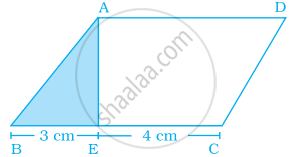
In the following figure, find the area of parallelogram ABCD if the area of shaded triangle is 9 cm2.