Advertisements
Advertisements
प्रश्न
A parallelogram has sides of 15 cm and 12 cm; if the distance between the 15 cm sides is 6 cm; find the distance between 12 cm sides.
Advertisements
उत्तर
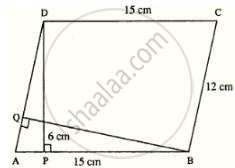
Base, AB = 15 cm
Distance between 15 cm sides
i.e. height DP = 6 cm
∴ Area of ||gm = Base × height
= AB × DP
= 15 × 6 = 90 cm2
Let BQ be the distance between 12 cm sides
∴ AD × BQ = area of ||gm ABCD
∴ 12 × BQ = 90
BQ = `90/12`
BQ = `15/2 = 7.5` cm
APPEARS IN
संबंधित प्रश्न
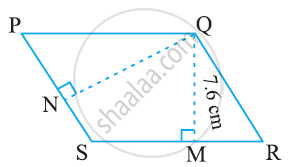
PQRS is a parallelogram (see the given figure). QM is the height from Q to SR and QN is the height from Q to PS. If SR = 12 cm and QM = 7.6 cm. Find:
- the area of the parallelogram PQRS
- QN, if PS = 8 cm
A parallelogram has sides of 20 cm and 30 cm. If the distance between its shorter sides is 15 cm; find the distance between the longer sides.
Suresh on a parallelogram-shaped trophy in a state level chess tournament. He knows that the area of the trophy is 735 sq.cm and its base is 21 cm. What is the height of that trophy?
Janaki has a piece of fabric in the shape of a parallelogram. Its height is 12 m and its base is 18 m. She cuts the fabric into four equal parallelograms by cutting the parallel sides through its mid-points. Find the area of each new parallelogram
If the base and height of a parallelogram are in the ratio 7 : 3 and the height is 45 cm, then fixed the area of the parallelogram
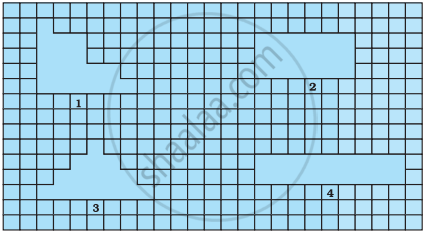
Observe the shapes 1, 2, 3 and 4 in the figures. Which of the following statements is not correct?
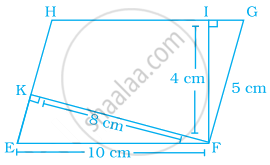
In the following figure, EFGH is a parallelogram, altitudes FK and FI are 8 cm and 4 cm respectively. If EF = 10 cm, then area of EFGH is ______.
If the sides of a parallelogram are increased to twice its original lengths, how much will the perimeter of the new parallelogram?
If perimeter of two parallelograms are equal, then their areas are also equal.
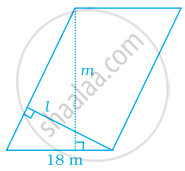
Perimeter of a parallelogram shaped land is 96 m and its area is 270 square metres. If one of the sides of this parallelogram is 18 m, find the length of the other side. Also, find the lengths of altitudes l and m (see figure).