Advertisements
Advertisements
Question
A parallelogram has sides of 15 cm and 12 cm; if the distance between the 15 cm sides is 6 cm; find the distance between 12 cm sides.
Advertisements
Solution
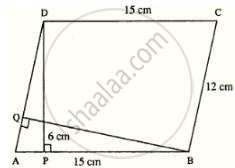
Base, AB = 15 cm
Distance between 15 cm sides
i.e. height DP = 6 cm
∴ Area of ||gm = Base × height
= AB × DP
= 15 × 6 = 90 cm2
Let BQ be the distance between 12 cm sides
∴ AD × BQ = area of ||gm ABCD
∴ 12 × BQ = 90
BQ = `90/12`
BQ = `15/2 = 7.5` cm
APPEARS IN
RELATED QUESTIONS
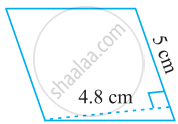
Find the area of the following parallelogram:
If area of a parallelogram is 29.6 sq cm and its base is 8 cm, find its height.
The adjacent sides of a parallelogram are 21 cm and 28 cm. If it's one diagonal is 35 cm; find the area of the parallelogram.
Find the missing values.
| Base | Height | Area |
| 17 mm | 221 sq.mm |
A ground is in the shape of parallelogram. The height of the parallelogram is 14 metres and the corresponding base is 8 metres longer than its height. Find the cost of levelling the ground at the rate of ₹ 15 per sq.m
The base of the parallelogram is 16 cm and the height is 7 cm less than its base. Find the area of the parallelogram
If the sides of a parallelogram are increased to twice its original lengths, how much will the perimeter of the new parallelogram?
To find area, any side of a parallelogram can be chosen as ______ of the parallelogram.
Perpendicular dropped on the base of a parallelogram from the opposite vertex is known as the corresponding ______ of the base.
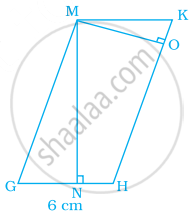
Altitudes MN and MO of parallelogram MGHK are 8 cm and 4 cm long respectively (see figure). One side GH is 6 cm long. Find the perimeter of MGHK.