Advertisements
Advertisements
प्रश्न
What happens to the area of the parallelogram if the base is increased 2 times and the height is halved?
पर्याय
Decreases to half
Remains the same
Increase by two times
None
Advertisements
उत्तर
Remains the same
Explanation;
Hint:
Area = b × h sq.units
New base = 2 × old base
New height = `1/2` × old height
New Area = New base × New height
= `(2 xx "b")1/2 xx "h"`
= bh
= old Area
APPEARS IN
संबंधित प्रश्न
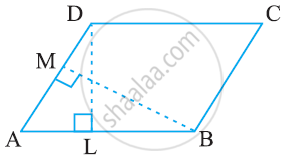
DL and BM are the heights on sides AB and AD respectively of parallelogram ABCD (see the given figure). If the area of the parallelogram is 1470 cm2, AB = 35 cm and AD = 49 cm, find the length of BM and DL.
A ground is in the shape of parallelogram. The height of the parallelogram is 14 metres and the corresponding base is 8 metres longer than its height. Find the cost of levelling the ground at the rate of ₹ 15 per sq.m
The area of parallelogram whose base 10 m and height 7 m is
In a parallelogram the base is three times its height. If the height is 8 cm then the area is
The base of the parallelogram is 16 cm and the height is 7 cm less than its base. Find the area of the parallelogram
Find the area of the parallelogram ABCD if AC is 24 cm and BE = DF = 8 cm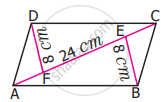
Find the height of the parallelogram whose base is four times the height and whose area is 576 sq.cm
Perpendicular dropped on the base of a parallelogram from the opposite vertex is known as the corresponding ______ of the base.
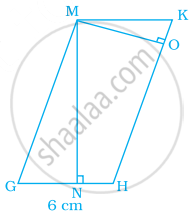
Altitudes MN and MO of parallelogram MGHK are 8 cm and 4 cm long respectively (see figure). One side GH is 6 cm long. Find the perimeter of MGHK.
ABCD is a parallelogram in which AE is perpendicular to CD (see figure). Also AC = 5 cm, DE = 4 cm and area of ΔAED = 6 cm2. Find the perimeter and area of ABCD.
