Advertisements
Advertisements
प्रश्न
The base of the parallelogram is 16 cm and the height is 7 cm less than its base. Find the area of the parallelogram
Advertisements
उत्तर
In a parallelogram
Given base b = 16 cm, height h = base – 7 cm
= 16 – 7
= 9 cm
Area of the parallelogram = (base × height) sq.units
= 16 × 9 cm2
= 144 cm2
Area of the parallelogram = 144 cm2
APPEARS IN
संबंधित प्रश्न
If base of a parallelogram is 18 cm and its height is 11 cm, find its area.
The adjacent sides of a parallelogram are 21 cm and 28 cm. If it's one diagonal is 35 cm; find the area of the parallelogram.
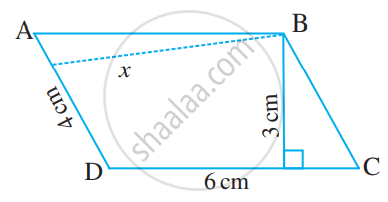
The two sides of the parallelogram ABCD are 6 cm and 4 cm. The height corresponding to the base CD is 3 cm.
Find the
(i) area of the parallelogram.
(ii) the height corresponding to the base AD.
Find the missing values.
| Base | Height | Area |
| 8 cm | 56 sq.m |
Suresh on a parallelogram-shaped trophy in a state level chess tournament. He knows that the area of the trophy is 735 sq.cm and its base is 21 cm. What is the height of that trophy?
A ground is in the shape of parallelogram. The height of the parallelogram is 14 metres and the corresponding base is 8 metres longer than its height. Find the cost of levelling the ground at the rate of ₹ 15 per sq.m
In a parallelogram the base is three times its height. If the height is 8 cm then the area is
To find area, any side of a parallelogram can be chosen as ______ of the parallelogram.
Perpendicular dropped on the base of a parallelogram from the opposite vertex is known as the corresponding ______ of the base.
Perimeter of a parallelogram shaped land is 96 m and its area is 270 square metres. If one of the sides of this parallelogram is 18 m, find the length of the other side. Also, find the lengths of altitudes l and m (see figure).