Advertisements
Advertisements
प्रश्न
Suresh on a parallelogram-shaped trophy in a state level chess tournament. He knows that the area of the trophy is 735 sq.cm and its base is 21 cm. What is the height of that trophy?
Advertisements
उत्तर
Given: Base (b) = 21 cm
Area of parallelogram = 735 sq.cm
b × h = 735
21 × h = 735
h = `735/21`
h = 35 cm
∴ Height of the trophy = 35 cm
APPEARS IN
संबंधित प्रश्न
A parallelogram has sides of 15 cm and 12 cm; if the distance between the 15 cm sides is 6 cm; find the distance between 12 cm sides.
The adjacent sides of a parallelogram are 21 cm and 28 cm. If it's one diagonal is 35 cm; find the area of the parallelogram.
Find the missing values.
| Base | Height | Area |
| 18 cm | 5 cm |
A ground is in the shape of parallelogram. The height of the parallelogram is 14 metres and the corresponding base is 8 metres longer than its height. Find the cost of levelling the ground at the rate of ₹ 15 per sq.m
The area of parallelogram whose base 10 m and height 7 m is
In a parallelogram the base is three times its height. If the height is 8 cm then the area is
The base of the parallelogram is 16 cm and the height is 7 cm less than its base. Find the area of the parallelogram
An agricultural field is in the form of a parallelogram, whose area is 68.75 sq.hm. The distance between the parallel sides is 6.25 cm. Find the length of the base
The height of the parallelogram is one-fourth of its base. If the area of the parallelogram is 676 sq.cm, find the height and the base
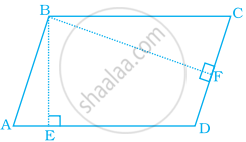
Area of parallelogram ABCD (see the figure) is not equal to ______.