Advertisements
Advertisements
प्रश्न
Janaki has a piece of fabric in the shape of a parallelogram. Its height is 12 m and its base is 18 m. She cuts the fabric into four equal parallelograms by cutting the parallel sides through its mid-points. Find the area of each new parallelogram
Advertisements
उत्तर
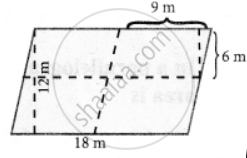
Area of a parallelogram = (base × height) sq.units
Base length = `18/2` = 9 m
Height = `12/2` = 6 m
Area = 9 × 6 = 54 m2
Area of each parallelogram = 54 m2
APPEARS IN
संबंधित प्रश्न
Find the missing value:
| Base | Height | Area of parallelogram |
| 20 cm | ______ | 246 cm2 |
A parallelogram has sides of 20 cm and 30 cm. If the distance between its shorter sides is 15 cm; find the distance between the longer sides.
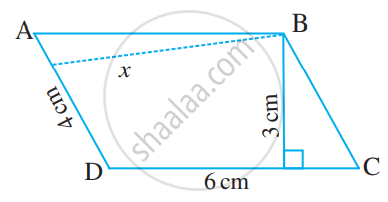
The two sides of the parallelogram ABCD are 6 cm and 4 cm. The height corresponding to the base CD is 3 cm.
Find the
(i) area of the parallelogram.
(ii) the height corresponding to the base AD.
The area of parallelogram whose base 10 m and height 7 m is
What happens to the area of the parallelogram if the base is increased 2 times and the height is halved?
If the base and height of a parallelogram are in the ratio 7 : 3 and the height is 45 cm, then fixed the area of the parallelogram
If the sides of a parallelogram are increased to twice its original lengths, how much will the perimeter of the new parallelogram?
In the following figure, area of parallelogram BCEF is ________ cm2 where ACDF is a rectangle.

In the following figure, area of ∆AFB is equal to the area of parallelogram ABCD. If altitude EF is 16 cm long, find the altitude of the parallelogram to the base AB of length 10 cm. What is the area of ∆DAO, where O is the midpoint of DC?

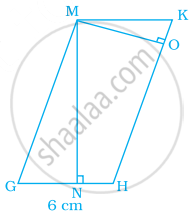
Altitudes MN and MO of parallelogram MGHK are 8 cm and 4 cm long respectively (see figure). One side GH is 6 cm long. Find the perimeter of MGHK.