Advertisements
Advertisements
प्रश्न
Find the missing values.
| Base | Height | Area |
| 17 mm | 221 sq.mm |
Advertisements
उत्तर
Given: Height h = 17 mm
Area of the parallelogram = 221 sq.mm
b × h = 221
b × 17 = 221
b = `221/17`
b = 13 m
Tabulating the results, we get
| Base | Height | Area |
| 13 m | 17 mm | 221 sq.mm |
APPEARS IN
संबंधित प्रश्न
Find the area of the following parallelogram:
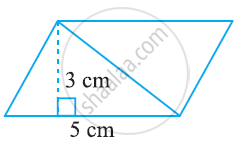
Find the area of the following parallelogram:
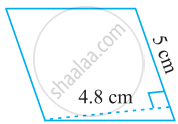
If base of a parallelogram is 18 cm and its height is 11 cm, find its area.
If area of a parallelogram is 29.6 sq cm and its base is 8 cm, find its height.
The two sides of the parallelogram ABCD are 6 cm and 4 cm. The height corresponding to the base CD is 3 cm.
Find the
(i) area of the parallelogram.
(ii) the height corresponding to the base AD.
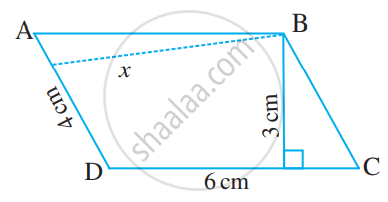
An agricultural field is in the form of a parallelogram, whose area is 68.75 sq.hm. The distance between the parallel sides is 6.25 cm. Find the length of the base
Find the area of the parallelogram ABCD if AC is 24 cm and BE = DF = 8 cm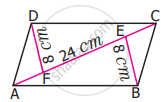
The area of the parallelogram ABCD is 1470 sq.cm. If AB = 49 cm and AD = 35 cm then, find the height, DF and BE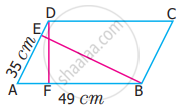
Area of parallelogram ABCD (see the figure) is not equal to ______.
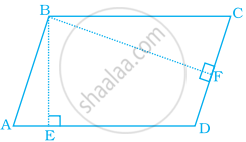
To find area, any side of a parallelogram can be chosen as ______ of the parallelogram.
