Advertisements
Advertisements
प्रश्न
Find the missing values.
| Base | Height | Area |
| 8 cm | 56 sq.m |
Advertisements
उत्तर
Base b = 8 m
Area of the parallelogram = 56 sq.m
b × h = 56
8 × A = 56
h = `56/8`
h = 7 m
Tabulating the results, we get
| Base | Height | Area |
| 8 cm | 7 m | 56 sq.m |
APPEARS IN
संबंधित प्रश्न
Find the missing value:
| Base | Height | Area of parallelogram |
| 20 cm | ______ | 246 cm2 |
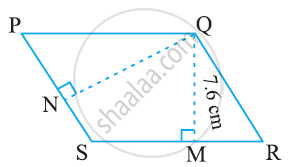
PQRS is a parallelogram (see the given figure). QM is the height from Q to SR and QN is the height from Q to PS. If SR = 12 cm and QM = 7.6 cm. Find:
- the area of the parallelogram PQRS
- QN, if PS = 8 cm
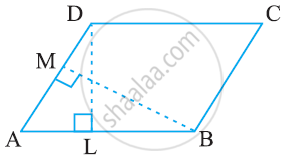
DL and BM are the heights on sides AB and AD respectively of parallelogram ABCD (see the given figure). If the area of the parallelogram is 1470 cm2, AB = 35 cm and AD = 49 cm, find the length of BM and DL.
If base of a parallelogram is 18 cm and its height is 11 cm, find its area.
The base of the parallelogram is 16 cm and the height is 7 cm less than its base. Find the area of the parallelogram
If the base and height of a parallelogram are in the ratio 7 : 3 and the height is 45 cm, then fixed the area of the parallelogram
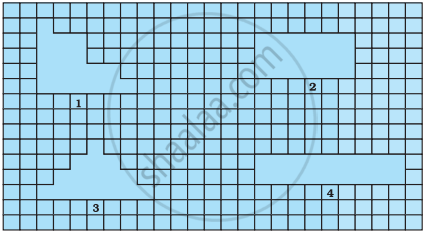
Observe the shapes 1, 2, 3 and 4 in the figures. Which of the following statements is not correct?
In the following figure, area of parallelogram BCEF is ________ cm2 where ACDF is a rectangle.

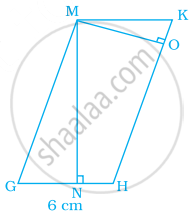
Altitudes MN and MO of parallelogram MGHK are 8 cm and 4 cm long respectively (see figure). One side GH is 6 cm long. Find the perimeter of MGHK.
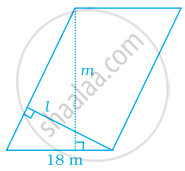
Perimeter of a parallelogram shaped land is 96 m and its area is 270 square metres. If one of the sides of this parallelogram is 18 m, find the length of the other side. Also, find the lengths of altitudes l and m (see figure).