Advertisements
Advertisements
प्रश्न
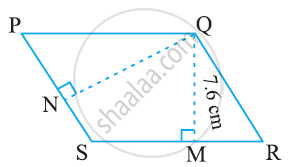
PQRS is a parallelogram (see the given figure). QM is the height from Q to SR and QN is the height from Q to PS. If SR = 12 cm and QM = 7.6 cm. Find:
- the area of the parallelogram PQRS
- QN, if PS = 8 cm
Advertisements
उत्तर
a. Area of parallelogram = Base × Height
= SR × QM
= 7.6 × 12
= 91.2 cm2
b. Area of parallelogram = Base × Height
91.2 cm2 = PS × QN
QN × 8 = 91.2
QN = `91.2/8`
QN = 11.4 cm
संबंधित प्रश्न
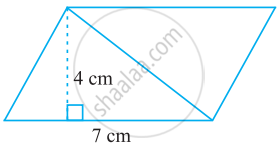
Find the area of the following parallelogram:
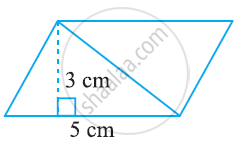
Find the area of the following parallelogram:
Find the missing value:
| Base | Height | Area of parallelogram |
| 20 cm | ______ | 246 cm2 |
If base of a parallelogram is 18 cm and its height is 11 cm, find its area.
The area of parallelogram whose base 10 m and height 7 m is
An agricultural field is in the form of a parallelogram, whose area is 68.75 sq.hm. The distance between the parallel sides is 6.25 cm. Find the length of the base
The height of the parallelogram is one-fourth of its base. If the area of the parallelogram is 676 sq.cm, find the height and the base
If the sides of a parallelogram are increased to twice its original lengths, how much will the perimeter of the new parallelogram?
To find area, any side of a parallelogram can be chosen as ______ of the parallelogram.
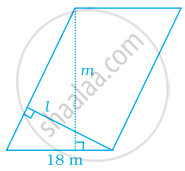
Perimeter of a parallelogram shaped land is 96 m and its area is 270 square metres. If one of the sides of this parallelogram is 18 m, find the length of the other side. Also, find the lengths of altitudes l and m (see figure).