Advertisements
Advertisements
प्रश्न
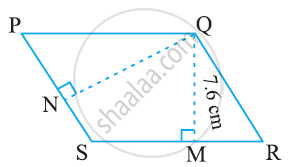
PQRS is a parallelogram (see the given figure). QM is the height from Q to SR and QN is the height from Q to PS. If SR = 12 cm and QM = 7.6 cm. Find:
- the area of the parallelogram PQRS
- QN, if PS = 8 cm
Advertisements
उत्तर
a. Area of parallelogram = Base × Height
= SR × QM
= 7.6 × 12
= 91.2 cm2
b. Area of parallelogram = Base × Height
91.2 cm2 = PS × QN
QN × 8 = 91.2
QN = `91.2/8`
QN = 11.4 cm
संबंधित प्रश्न
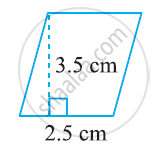
Find the area of the following parallelogram:
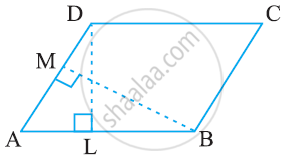
DL and BM are the heights on sides AB and AD respectively of parallelogram ABCD (see the given figure). If the area of the parallelogram is 1470 cm2, AB = 35 cm and AD = 49 cm, find the length of BM and DL.
A parallelogram has sides of 20 cm and 30 cm. If the distance between its shorter sides is 15 cm; find the distance between the longer sides.
Janaki has a piece of fabric in the shape of a parallelogram. Its height is 12 m and its base is 18 m. She cuts the fabric into four equal parallelograms by cutting the parallel sides through its mid-points. Find the area of each new parallelogram
The area of parallelogram whose base 10 m and height 7 m is
A square and a parallelogram have the same area. If the side of the square is 48 m and the height of the parallelogram is 18 m. Find the length of the base of the parallelogram
In a parallelogram PQRS (See the diagram) PM and PN are the heights corresponding to the sides QR and RS respectively. If the area of the parallelogram is 900 sq.cm and the length of PM and PN are 20 cm and 36 cm respectively, find the length of the sides QR and SR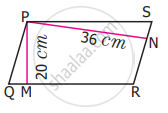
Find the height of the parallelogram whose base is four times the height and whose area is 576 sq.cm
Observe the shapes 1, 2, 3 and 4 in the figures. Which of the following statements is not correct?
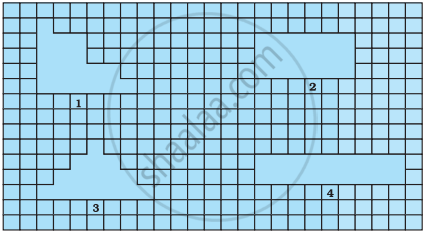
All parallelograms having equal areas have same perimeters.
