Advertisements
Advertisements
प्रश्न
In a parallelogram the base is three times its height. If the height is 8 cm then the area is
विकल्प
64 sq.cm
192 sq.cm
32 sq.cm
72 sq.cm
Advertisements
उत्तर
192 sq.cm
Explanation;
Hint: Given b = 3 × h, h = 8 cm
Area = b × h
= 3h × 8
= 3 × 8 × 8
= 192 cm2
APPEARS IN
संबंधित प्रश्न
Find the area of the following parallelogram:
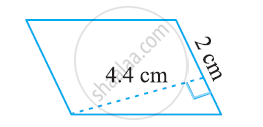
If area of a parallelogram is 29.6 sq cm and its base is 8 cm, find its height.
The adjacent sides of a parallelogram are 21 cm and 28 cm. If it's one diagonal is 35 cm; find the area of the parallelogram.
A square and a parallelogram have the same area. If the side of the square is 48 m and the height of the parallelogram is 18 m. Find the length of the base of the parallelogram
Find the area of the parallelogram ABCD if AC is 24 cm and BE = DF = 8 cm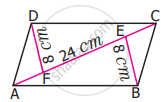
The area of the parallelogram ABCD is 1470 sq.cm. If AB = 49 cm and AD = 35 cm then, find the height, DF and BE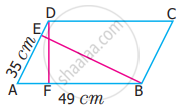
Find the missing value:
| Base | Height | Area of parallelogram |
| 15.6 cm | ______ | 16.38 cm2 |
Observe the shapes 1, 2, 3 and 4 in the figures. Which of the following statements is not correct?
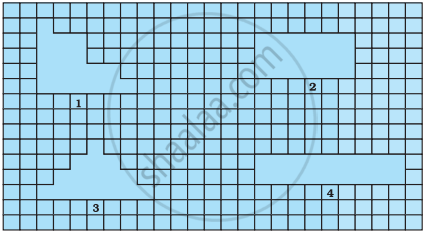
If the sides of a parallelogram are increased to twice its original lengths, how much will the perimeter of the new parallelogram?
In the following figure, area of ∆AFB is equal to the area of parallelogram ABCD. If altitude EF is 16 cm long, find the altitude of the parallelogram to the base AB of length 10 cm. What is the area of ∆DAO, where O is the midpoint of DC?

