Advertisements
Advertisements
प्रश्न
A square and a parallelogram have the same area. If the side of the square is 48 m and the height of the parallelogram is 18 m. Find the length of the base of the parallelogram
Advertisements
उत्तर
Given side of the square is 48 m
Area of the square = (side × side) sq.unit
= 48 × 48 m2
Height of the parallelogram = 18 m
Area of the parallelogram = ‘bh’ sq.units
= b × 18 m2
Also area of the parallelogram = Area of the square
b × 18 = 48 × 48
b = `(48 xx 48)/18`
= 8 × 16
= 128 m
Base of the parallelogram = 128 m
APPEARS IN
संबंधित प्रश्न
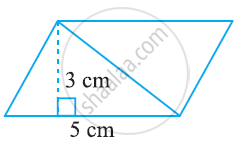
Find the area of the following parallelogram:
If area of a parallelogram is 29.6 sq cm and its base is 8 cm, find its height.
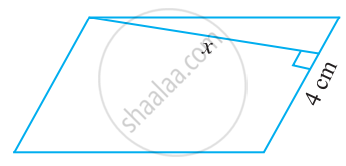
Find the height ‘x’ if the area of the parallelogram is 24 cm2 and the base is 4 cm.
Find the missing values.
| Base | Height | Area |
| 17 mm | 221 sq.mm |
The base of the parallelogram with area is 52 sq.cm and height 4 cm is
In a parallelogram the base is three times its height. If the height is 8 cm then the area is
An agricultural field is in the form of a parallelogram, whose area is 68.75 sq.hm. The distance between the parallel sides is 6.25 cm. Find the length of the base
Find the area of the parallelogram ABCD if AC is 24 cm and BE = DF = 8 cm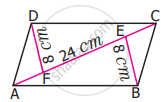
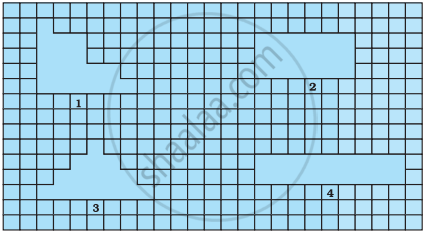
Observe the shapes 1, 2, 3 and 4 in the figures. Which of the following statements is not correct?
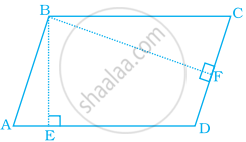
Area of parallelogram ABCD (see the figure) is not equal to ______.