Advertisements
Advertisements
प्रश्न
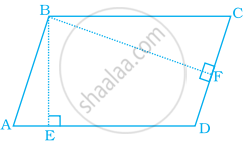
Area of parallelogram ABCD (see the figure) is not equal to ______.
विकल्प
DE × DC
BE × AD
BF × DC
BE × BC
Advertisements
उत्तर
Area of parallelogram ABCD (see the figure) is not equal to DE × DC.
Explanation:
We know that,
Area of parallelogram = Base × Corresponding height
So, area of parallelogram ABCD = AD × BE = BC × BE ...[∵ AD = BC]
or area of parallelogram ABCD = DC × BF
APPEARS IN
संबंधित प्रश्न
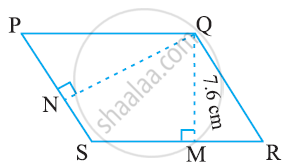
PQRS is a parallelogram (see the given figure). QM is the height from Q to SR and QN is the height from Q to PS. If SR = 12 cm and QM = 7.6 cm. Find:
- the area of the parallelogram PQRS
- QN, if PS = 8 cm
A parallelogram has sides of 20 cm and 30 cm. If the distance between its shorter sides is 15 cm; find the distance between the longer sides.
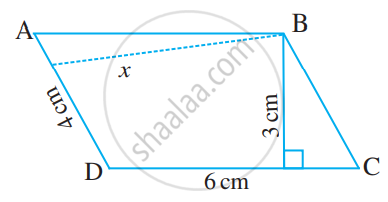
The two sides of the parallelogram ABCD are 6 cm and 4 cm. The height corresponding to the base CD is 3 cm.
Find the
(i) area of the parallelogram.
(ii) the height corresponding to the base AD.
Find the missing values.
| Base | Height | Area |
| 18 cm | 5 cm |
Find the missing values.
| Base | Height | Area |
| 8 cm | 56 sq.m |
A square and a parallelogram have the same area. If the side of the square is 48 m and the height of the parallelogram is 18 m. Find the length of the base of the parallelogram
If the base and height of a parallelogram are in the ratio 7 : 3 and the height is 45 cm, then fixed the area of the parallelogram
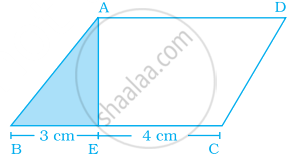
In the following figure, find the area of parallelogram ABCD if the area of shaded triangle is 9 cm2.
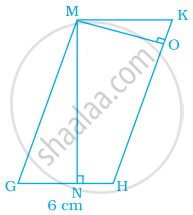
Altitudes MN and MO of parallelogram MGHK are 8 cm and 4 cm long respectively (see figure). One side GH is 6 cm long. Find the perimeter of MGHK.
ABCD is a parallelogram in which AE is perpendicular to CD (see figure). Also AC = 5 cm, DE = 4 cm and area of ΔAED = 6 cm2. Find the perimeter and area of ABCD.
