Advertisements
Advertisements
प्रश्न
Area of triangle MNO in the following figure is ______.

विकल्प
`1/2` MN × NO
`1/2` NO × MO
`1/2` MN × OQ
`1/2` NO × OQ
Advertisements
उत्तर
Area of triangle MNO in the following figure is `underlinebb(1/2 NO xx OQ)`.
Explanation:
MNO is a triangle
We know that, area of triangle = `1/2` (base × height)
= `1/2` × NO × OQ
APPEARS IN
संबंधित प्रश्न
If the points A(−2, 1), B(a, b) and C(4, −1) are collinear and a − b = 1, find the values of a and b.
If the points P(–3, 9), Q(a, b) and R(4, – 5) are collinear and a + b = 1, find the values of a and b.
Find the area of the triangle PQR with Q(3, 2) and the mid-points of the sides through Q being (2, –1) and (1, 2).
If D, E and F are the mid-points of sides BC, CA and AB respectively of a ∆ABC, then using coordinate geometry prove that Area of ∆DEF = `\frac { 1 }{ 4 } "(Area of ∆ABC)"`
Find the area of the quadrilateral whose vertices, taken in order, are (–4, –2), (–3, –5), (3, –2) and (2, 3).
Find the area of a triangle two sides of which are 18 cm and 10 cm and the perimeter is 42cm?
If the points P(–3, 9), Q(a, b) and R(4, –5) are collinear and a + b = 1, find the values of a and b.
If the area of triangle ABC formed by A(x, y), B(1, 2) and C(2, 1) is 6 square units, then prove that x + y = 15 ?
Find the coordinates of the point Q on the x-axis which lies on the perpendicular bisector of the line segment joining the points A(–5, –2) and B(4, –2). Name the type of triangle formed by the points Q, A and B.
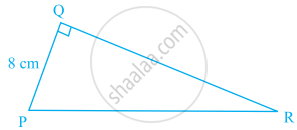
Area of a triangle PQR right-angled at Q is 60 cm2 (see figure). If the smallest side is 8 cm long, find the length of the other two sides.