Advertisements
Advertisements
प्रश्न
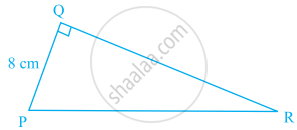
Area of a triangle PQR right-angled at Q is 60 cm2 (see figure). If the smallest side is 8 cm long, find the length of the other two sides.
Advertisements
उत्तर
Given, area of ΔPQR = 60 cm2 and side PQ = 8 cm
∴ Area of ΔPQR = `1/2` × PQ × QR ...[∵ Area of triangle = Base × Height]
⇒ 60 = `1/2` × 8 × QR
⇒ QR = `(60 xx 2)/8`
⇒ QR = 15 cm
In right-angled ΔPQR,
PR2 + PQ2 + QR2 ...[By Pythagoras theorem]
⇒ PR2 + 82 + 152 = 64 + 225
⇒ PR2 = 289
⇒ PR = `sqrt(289)` = 17 cm
Hence, the length of two sides are 15 cm and 17 cm.
APPEARS IN
संबंधित प्रश्न
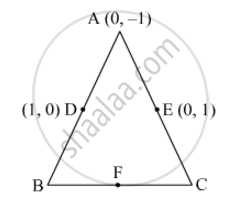
In Fig. 6, ABC is a triangle coordinates of whose vertex A are (0, −1). D and E respectively are the mid-points of the sides AB and AC and their coordinates are (1, 0) and (0, 1) respectively. If F is the mid-point of BC, find the areas of ∆ABC and ∆DEF.
The perimeter of a right triangle is 60 cm. Its hypotenuse is 25 cm. Find the area of the triangle.
If D, E and F are the mid-points of sides BC, CA and AB respectively of a ∆ABC, then using coordinate geometry prove that Area of ∆DEF = `\frac { 1 }{ 4 } "(Area of ∆ABC)"`
If area of triangle is 35 sq. units with vertices (2, −6), (5, 4) and (k, 4), then k is ______.
If the coordinates of the mid-points of the sides of a triangle are (1, 1), (2, —3) and (3, 4), find the vertices of the triangle.
The perimeter of a triangular field is 540 m and its sides are in the ratio 25 : 17 : 12. Find the area of the triangle.
Find the area of ΔABC whose vertices are A(1, 2) B(–2, 3) and C(–3, –4).
Find the area of ΔABC whose vertices are A(10, –6), B(2, 5) and C(–1, 3).
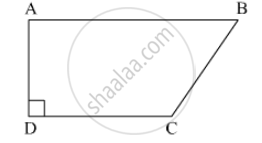
In ☐ABCD, l(AB) = 13 cm, l(DC) = 9 cm, l(AD) = 8 cm, find the area of ☐ABCD.
Find the area of the triangle whose vertices are (-2, 6), (3, -6), and (1, 5).
