Advertisements
Advertisements
प्रश्न
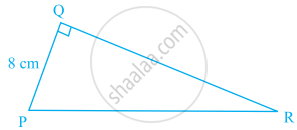
Area of a triangle PQR right-angled at Q is 60 cm2 (see figure). If the smallest side is 8 cm long, find the length of the other two sides.
Advertisements
उत्तर
Given, area of ΔPQR = 60 cm2 and side PQ = 8 cm
∴ Area of ΔPQR = `1/2` × PQ × QR ...[∵ Area of triangle = Base × Height]
⇒ 60 = `1/2` × 8 × QR
⇒ QR = `(60 xx 2)/8`
⇒ QR = 15 cm
In right-angled ΔPQR,
PR2 + PQ2 + QR2 ...[By Pythagoras theorem]
⇒ PR2 + 82 + 152 = 64 + 225
⇒ PR2 = 289
⇒ PR = `sqrt(289)` = 17 cm
Hence, the length of two sides are 15 cm and 17 cm.
APPEARS IN
संबंधित प्रश्न
Find the relation between x and y if, the points A(x, y), B(-5, 7) and C(-4, 5) are collinear.
If A(4, –6), B(3, –2) and C(5, 2) are the vertices of ∆ABC, then verify the fact that a median of a triangle ABC divides it into two triangle of equal areas.
If area of triangle is 35 sq. units with vertices (2, −6), (5, 4) and (k, 4), then k is ______.
The four vertices of a quadrilateral are (1, 2), (−5, 6), (7, −4) and (k, −2) taken in order. If the area of the quadrilateral is zero, find the value of k.
Prove that the points (2a, 4a), (2a, 6a) and `(2a + sqrt3a, 5a)` are the vertices of an equilateral triangle.
Two vertices of a triangle are (1, 2), (3, 5) and its centroid is at the origin. Find the coordinates of the third vertex.
Prove that the points A(2, 4), B(2, 6) and `C(2 + sqrt(3), 5)` are the vertices of an equilateral triangle.
The coordinates of the point P dividing the line segment joining the points A (1, 3) and B (4, 6) in the ratio 2 : 1 are:
Show that the ∆ABC is an isosceles triangle if the determinant
Δ = `[(1, 1, 1),(1 + cos"A", 1 + cos"B", 1 + cos"C"),(cos^2"A" + cos"A", cos^2"B" + cos"B", cos^2"C" + cos"C")]` = 0
The value of the determinant `abs((1,"x","x"^3),(1,"y","y"^3),(1,"z","z"^3))` is ____________.
