Advertisements
Advertisements
Question
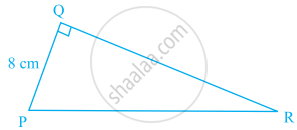
Area of a triangle PQR right-angled at Q is 60 cm2 (see figure). If the smallest side is 8 cm long, find the length of the other two sides.
Advertisements
Solution
Given, area of ΔPQR = 60 cm2 and side PQ = 8 cm
∴ Area of ΔPQR = `1/2` × PQ × QR ...[∵ Area of triangle = Base × Height]
⇒ 60 = `1/2` × 8 × QR
⇒ QR = `(60 xx 2)/8`
⇒ QR = 15 cm
In right-angled ΔPQR,
PR2 + PQ2 + QR2 ...[By Pythagoras theorem]
⇒ PR2 + 82 + 152 = 64 + 225
⇒ PR2 = 289
⇒ PR = `sqrt(289)` = 17 cm
Hence, the length of two sides are 15 cm and 17 cm.
APPEARS IN
RELATED QUESTIONS
Find the area of the triangle PQR with Q(3, 2) and the mid-points of the sides through Q being (2, –1) and (1, 2).
Find the area of the triangle formed by joining the mid-point of the sides of the triangle whose vertices are (0, –1), (2, 1) and (0, 3). Find the ratio of area of the triangle formed to the area of the given triangle.
The vertices of ∆ABC = are A (4, 6), B(1, 5) and C(7, 2). A line is drawn to intersect sides AB and AC at D and E respectively such that `\frac{AD}{AB}=\frac{AE}{AC}=\frac{1}{4}` .Calculate the area of ∆ADE and compare it with the area of ∆ABC
Show that the following sets of points are collinear.
(2, 5), (4, 6) and (8, 8)
For what value of a the point (a, 1), (1, –1) and (11, 4) are collinear?
If the coordinates of the mid-points of the sides of a triangle are (1, 1), (2, —3) and (3, 4), find the vertices of the triangle.
If A(5, 2), B(2, –2) and C(–2, t) are the vertices of a right triangle with ∠B = 90°, then find the value of t.
Show that the points O(0, 0), `A(3, sqrt(3))` and `B(3, -sqrt(3))` are the vertices of an equilateral triangle. Find the area of this triangle.
Find the value of x for which the points A(x, 2), B(–3, –4) and C(7, –5) are collinear.
If the points (a1, b1), (a2, b2) and(a1 + a2, b1 + b2) are collinear, then ____________.
