Advertisements
Advertisements
Question
Area of triangle MNO in the following figure is ______.

Options
`1/2` MN × NO
`1/2` NO × MO
`1/2` MN × OQ
`1/2` NO × OQ
Advertisements
Solution
Area of triangle MNO in the following figure is `underlinebb(1/2 NO xx OQ)`.
Explanation:
MNO is a triangle
We know that, area of triangle = `1/2` (base × height)
= `1/2` × NO × OQ
APPEARS IN
RELATED QUESTIONS
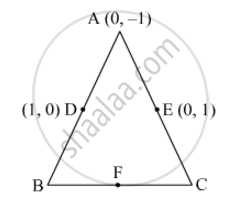
In Fig. 6, ABC is a triangle coordinates of whose vertex A are (0, −1). D and E respectively are the mid-points of the sides AB and AC and their coordinates are (1, 0) and (0, 1) respectively. If F is the mid-point of BC, find the areas of ∆ABC and ∆DEF.
In each of the following find the value of 'k', for which the points are collinear.
(7, -2), (5, 1), (3, -k)
The area of a triangle is 5. Two of its vertices are (2, 1) and (3, –2). The third vertex lies on y = x + 3. Find the third vertex.
Prove that the lines joining the middle points of the opposite sides of a quadrilateral and the join of the middle points of its diagonals meet in a point and bisect one another
Find the area of ΔABC whose vertices is A(–5, 7), B(–4, –5) and C(4, 5).
Using integration, find the area of triangle ABC, whose vertices are A(2, 5), B(4, 7) and C(6, 2).
If the points (2, -3), (k, -1), and (0, 4) are collinear, then find the value of 4k.
Points A(–6, 10), B(–4, 6) and C(3, –8) are collinear such that AB = `2/9` AC.
Ratio of areas of ∆MNO, ∆MOP and ∆MPQ in the following figure is ______.

If (a, b), (c, d) and (e, f) are the vertices of ΔABC and Δ denotes the area of ΔABC, then `|(a, c, e),(b, d, f),(1, 1, 1)|^2` is equal to ______.
