Advertisements
Advertisements
Question
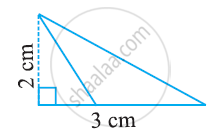
Find the area of the following triangle:
Advertisements
Solution
Area of triangle = `1/2 xx "Base" xx "Height"`
Base = 3 cm,
Height = 2 cm
Area = `1/2 xx 3 xx 2`
= 3cm2
RELATED QUESTIONS
Prove that the points (a, b + c), (b, c + a) and (c, a + b) are collinear
The area of a triangle is 5. Two of its vertices are (2, 1) and (3, –2). The third vertex lies on y = x + 3. Find the third vertex.
Prove that the points (a, b), (a1, b1) and (a −a1, b −b1) are collinear if ab1 = a1b.
Find the area of a triangle whose sides are respectively 150 cm, 120 cm and 200 cm ?
In a ΔABC, AB = 15 cm, BC = 13 cm and AC = 14 cm. Find the area of ΔABC and hence its altitude on AC ?
Find the centroid of ΔABC whose vertices are A(–1, 0), B(5, –2) and C(8, 2).
Find the value(s) of p for which the points (3p + 1, p), (p + 2, p – 5) and (p + 1, –p) are collinear ?
If the points (2, -3), (k, -1), and (0, 4) are collinear, then find the value of 4k.
Area of a triangle = `1/2` base × ______.
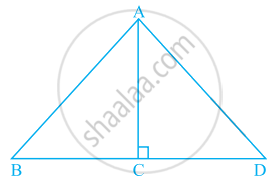
In the following figure, ratio of the area of triangle ABC to the area of triangle ACD is the same as the ratio of base BC of triangle ABC to the base CD of triangle ACD.