Advertisements
Advertisements
Question
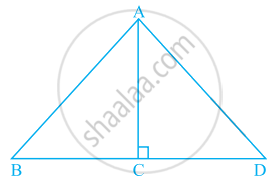
In the following figure, ratio of the area of triangle ABC to the area of triangle ACD is the same as the ratio of base BC of triangle ABC to the base CD of triangle ACD.
Options
True
False
Advertisements
Solution
This statement is True.
Explanation:
Area of a triangle ABC = `1/2 xx BC xx AC`
Area of a triangle ACD = `1/2 xx CD xx AC`
Now, their ratio = `(1/2 xx BC xx AC)/(1/2 xx CD xx AC)`
= `(BC)/(CD)` or BC : CD
APPEARS IN
RELATED QUESTIONS
Find the area of the triangle ABC with A(1, −4) and mid-points of sides through A being (2, −1) and (0, −1).
Prove that the points (2, – 2), (–3, 8) and (–1, 4) are collinear
Find the area of the triangle whose vertices are: (2, 3), (-1, 0), (2, -4)
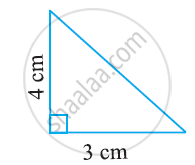
Find the area of the following triangle:
Find the area of a triangle two sides of which are 18 cm and 10 cm and the perimeter is 42cm?
Find the third vertex of a ΔABC if two of its vertices are B(–3, 1) and C(0, –2) and its centroid is at the origin.
Area of triangle MNO in the following figure is ______.

Triangles having the same base have equal area.
If (a, b), (c, d) and (e, f) are the vertices of ΔABC and Δ denotes the area of ΔABC, then `|(a, c, e),(b, d, f),(1, 1, 1)|^2` is equal to ______.
Find the missing value:
| Base | Height | Area of Triangle |
| 22 cm | ______ | 170.5 cm2 |
