Advertisements
Advertisements
प्रश्न
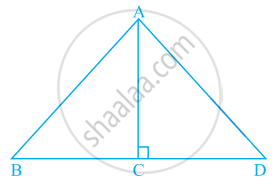
In the following figure, ratio of the area of triangle ABC to the area of triangle ACD is the same as the ratio of base BC of triangle ABC to the base CD of triangle ACD.
विकल्प
True
False
Advertisements
उत्तर
This statement is True.
Explanation:
Area of a triangle ABC = `1/2 xx BC xx AC`
Area of a triangle ACD = `1/2 xx CD xx AC`
Now, their ratio = `(1/2 xx BC xx AC)/(1/2 xx CD xx AC)`
= `(BC)/(CD)` or BC : CD
APPEARS IN
संबंधित प्रश्न
If the points P(–3, 9), Q(a, b) and R(4, – 5) are collinear and a + b = 1, find the values of a and b.
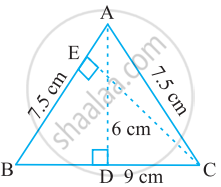
ΔABC is isosceles with AB = AC = 7.5 cm and BC = 9 cm (see the given figure). The height AD from A to BC, is 6 cm. Find the area of ΔABC. What will be the height from C to AB i.e., CE?
If A(–5, 7), B(–4, –5), C(–1, –6) and D(4, 5) are the vertices of a quadrilateral, find the area of the quadrilateral ABCD
If A(5, 2), B(2, –2) and C(–2, t) are the vertices of a right triangle with ∠B = 90°, then find the value of t.
Show that the points O(0, 0), `A(3, sqrt(3))` and `B(3, -sqrt(3))` are the vertices of an equilateral triangle. Find the area of this triangle.
Show that the points A(3, 1), B(0, –2), C(1, 1) and D(4, 4) are the vertices of a parallelogram ABCD.
Find a relation between x and y, if the points A(2, 1), B(x, y) and C(7,5) are collinear.
Find the area of the triangle whose vertices are (-2, 6), (3, -6), and (1, 5).
Find the area of the triangle whose vertices are (–8, 4), (–6, 6) and (–3, 9).
Find the missing value:
| Base | Height | Area of Triangle |
| ______ | 31.4 mm | 1256 mm2 |
