Advertisements
Advertisements
प्रश्न
Observe all the four triangles FAB, EAB, DAB and CAB as shown in the following figure.

- All triangles have the same base and the same altitude.
- All triangles are congruent.
- All triangles are equal in area.
- All triangles may not have the same perimeter.
Advertisements
उत्तर
1. True.
It is clear from the figure that all triangles have same base AB and all the vertices lie on the same line, so the distance between vertex and base of triangle (i.e. length of altitude) are equal.
2. False
It is clear from the figure that all triangles have only base line is equal and no such other lines are equal to each other.
3. True
Because the triangles on same base and between same parallel lines have equal in area.
4. True
It is clear from the figure that all triangles may not have the same perimeter.
APPEARS IN
संबंधित प्रश्न
Find the values of k for which the points A(k + 1, 2k), B(3k, 2k + 3) and (5k – 1, 5k) are collinear.
Prove that the points (2, – 2), (–3, 8) and (–1, 4) are collinear
The class X students of a secondary school in Krishinagar have been allotted a rectangular plot of land for their gardening activity. Saplings of Gulmohar are planted on the boundary at a distance of 1 m from each other. There is a triangular grassy lawn in the plot as shown in the following figure. The students are to sow seeds of flowering plants on the remaining area of the plot.
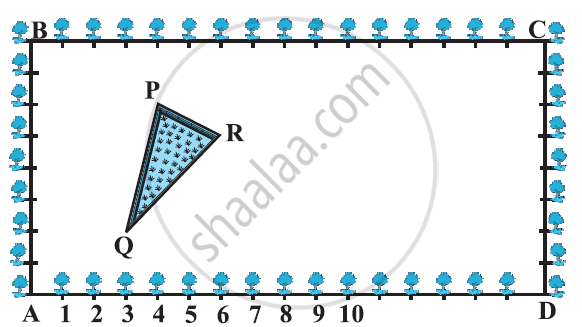
(i) Taking A as origin, find the coordinates of the vertices of the triangle.
(ii) What will be the coordinates of the vertices of Δ PQR if C is the origin?
Also calculate the areas of the triangles in these cases. What do you observe?
Find the centroid of the triangle whose vertices is (1, 4), (–1, –1) and (3, –2).
Show that the points O(0, 0), `A(3, sqrt(3))` and `B(3, -sqrt(3))` are the vertices of an equilateral triangle. Find the area of this triangle.
If the sides of a triangle are 3 cm, 4 cm and 5 cm, then the area is
If the co-ordinates of the vertices of an equilateral triangle with sides of length ‘a’ are (x1, y1), (x2, y2), (x3, y3), then `|(x_1, y_1, 1),(x_2, y_2, 1),(x_3, y_3, 1)|^2 = (3"a"^4)/4`
If the points (a1, b1), (a2, b2) and(a1 + a2, b1 + b2) are collinear, then ____________.
Points A(3, 1), B(12, –2) and C(0, 2) cannot be the vertices of a triangle.
Area of a triangle = `1/2` base × ______.
