Advertisements
Advertisements
प्रश्न
Area of triangle PQR is 100 cm2 (see figure). If altitude QT is 10 cm, then its base PR is ______.

विकल्प
20 cm
15 cm
10 cm
5 cm
Advertisements
उत्तर
Area of triangle PQR is 100 cm2 (see figure). If altitude QT is 10 cm, then its base PR is 20 cm.
Explanation:
We know that, area of triangle = `1/2` × base × height
From the question, it is given that, area of triangle PQR = 100 cm2
Height of the triangle = 10 cm = altitude
Therefore, area of triangle = `1/2` × base × height
100 = `1/2` × PR × 10
PR = `(100 xx 2)/10`
PR = `200/10`
PR = 20 cm
APPEARS IN
संबंधित प्रश्न
Let A (4, 2), B (6, 5) and C (1, 4) be the vertices of ΔABC.
(i) The median from A meets BC at D. Find the coordinates of point D.
(ii) Find the coordinates of the point P on AD such that AP: PD = 2:1
(iii) Find the coordinates of point Q and R on medians BE and CF respectively such that BQ: QE = 2:1 and CR: RF = 2:1.
(iv) What do you observe?
(v) If A(x1, y1), B(x2, y2), and C(x3, y3) are the vertices of ΔABC, find the coordinates of the centroid of the triangle.
The four vertices of a quadrilateral are (1, 2), (−5, 6), (7, −4) and (k, −2) taken in order. If the area of the quadrilateral is zero, find the value of k.
Show that the following sets of points are collinear.
(1, −1), (2, 1) and (4, 5)
If the coordinates of the mid-points of the sides of a triangle are (1, 1), (2, —3) and (3, 4), find the vertices of the triangle.
For what value of x are the points A(−3, 12), B(7, 6) and C(x, 9) collinear.
Using integration, find the area of the triangle whose vertices are (2, 3), (3, 5) and (4, 4).
Show that the ∆ABC is an isosceles triangle if the determinant
Δ = `[(1, 1, 1),(1 + cos"A", 1 + cos"B", 1 + cos"C"),(cos^2"A" + cos"A", cos^2"B" + cos"B", cos^2"C" + cos"C")]` = 0
The area of a trapezium is 475 cm2 and the height is 19 cm. Find the lengths of its two parallel sides if one side is 4 cm greater than the other.
In the following figure, ratio of the area of triangle ABC to the area of triangle ACD is the same as the ratio of base BC of triangle ABC to the base CD of triangle ACD.
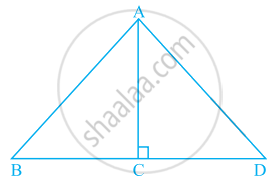
Triangles having the same base have equal area.
