Advertisements
Advertisements
प्रश्न
In the following figure, if PR = 12 cm, QR = 6 cm and PL = 8 cm, then QM is ______.

विकल्प
6 cm
9 cm
4 cm
2 cm
Advertisements
उत्तर
In the following figure, if PR = 12 cm, QR = 6 cm and PL = 8 cm, then QM is 4 cm.
Explanation:
Given that, PR = 12 cm, QR = 6 cm and PL = 8 cm
Now, In right angled ΔPLR, using Pythagoras theorem,
(Hypotenuse)2 = (Perpendicular)2 + (Base)2
⇒ PR2 = PL2 + LR2
⇒ LR2 = PR2 – PL2 = (12)2 – (8)2
⇒ LR2 = 144 – 64 = 80
⇒ LR = `sqrt(80) = 4sqrt(5)` cm
∵ LR = LQ + QR
⇒ LQ = LR – QR = `(4sqrt(5) - 6)` cm
Now, area of ΔPLR,
`A_1 = 1/2 xx LR xx PL`
= `1/2 xx (4sqrt(5)) xx 8`
= `16sqrt(5)` cm2
Again, area of ΔPLQ,
`A_2 = 1/2 xx LQ xx PL`
= `1/2 xx (4sqrt(5) - 6) xx 8`
= `(16sqrt(5) - 24)` cm2
∴ Area of ΔPLR = Area of ΔPLQ + Area of ΔPQR
⇒ `16sqrt(5) = (16sqrt(5) - 24)` + Area of ΔPQR
⇒ Area of ΔPQR = 24 cm2
⇒ `1/2 xx PR xx QM = 24`
⇒ `1/2 xx 12 xx QM = 24`
∴ QM = 4 cm
APPEARS IN
संबंधित प्रश्न
Find the relation between x and y if, the points A(x, y), B(-5, 7) and C(-4, 5) are collinear.
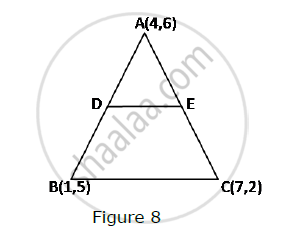
In Fig. 8, the vertices of ΔABC are A(4, 6), B(1, 5) and C(7, 2). A line-segment DE is drawn to intersect the sides AB and AC at D and E respectively such that `(AD)/(AB)=(AE)/(AC)=1/3 `Calculate th area of ADE and compare it with area of ΔABCe.
Find the area of the triangle PQR with Q(3, 2) and the mid-points of the sides through Q being (2, –1) and (1, 2).
For what value of k are the points (k, 2 – 2k), (–k + 1, 2k) and (–4 – k, 6 – 2k) are collinear ?
In each of the following find the value of 'k', for which the points are collinear.
(8, 1), (k, -4), (2, -5)
Prove that the points (a, b), (a1, b1) and (a −a1, b −b1) are collinear if ab1 = a1b.
If G(–2, 1) is the centroid of a ΔABC and two of its vertices are A(1, –6) and B(–5, 2), find the third vertex of the triangle.
Find the area of the triangle whose vertices are (-2, 6), (3, -6), and (1, 5).
The area of a triangle with vertices (a, b + c), (b, c + a) and (c, a + b) is ______.
The dimensions of a rectangle ABCD are 51 cm × 25 cm. A trapezium PQCD with its parallel sides QC and PD in the ratio 9 : 8, is cut off from the rectangle as shown in the following figure. If the area of the trapezium PQCD is `5/6` th part of the area of the rectangle, find the lengths QC and PD.

