Advertisements
Advertisements
प्रश्न
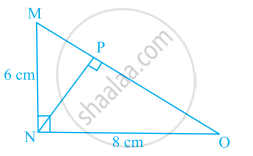
In the following figure, ΔMNO is a right-angled triangle. Its legs are 6 cm and 8 cm long. Length of perpendicular NP on the side MO is ______.
विकल्प
4.8 cm
3.6 cm
2.4 cm
1.2 cm
Advertisements
उत्तर
In the following figure, ΔMNO is a right-angled triangle. Its legs are 6 cm and 8 cm long. Length of perpendicular NP on the side MO is 4.8 cm.
Explanation:
Given, ΔMNO is a right angled triangle.
So, according to Pythagoras theorem,
MO2 = MN2 + NO2
= 62 + 82
= 36 + 64
⇒ MO2 = 100
⇒ MO = `sqrt(100)`
⇒ MO = 10 cm
∴ Area of ΔMNO = `1/2` × Base × Height
⇒ `1/2` × MN × NO = `1/2` × MO × NP
⇒ `1/2` × 6 × 8 = `1/2` × 10 × NP
⇒ NP = `24/5`
⇒ NP = 4.8 cm
APPEARS IN
संबंधित प्रश्न
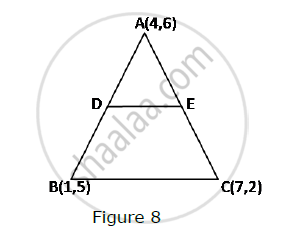
In Fig. 8, the vertices of ΔABC are A(4, 6), B(1, 5) and C(7, 2). A line-segment DE is drawn to intersect the sides AB and AC at D and E respectively such that `(AD)/(AB)=(AE)/(AC)=1/3 `Calculate th area of ADE and compare it with area of ΔABCe.
The perimeter of a right triangle is 60 cm. Its hypotenuse is 25 cm. Find the area of the triangle.
In each of the following find the value of 'k', for which the points are collinear.
(8, 1), (k, -4), (2, -5)
Find a relation between x and y, if the points A(2, 1), B(x, y) and C(7,5) are collinear.
Find the value of p for which the points (−5, 1), (1, p) and (4, −2) are collinear.
In a triangle ABC, if `|(1, 1, 1),(1 + sin"A", 1 + sin"B", 1 + sin"C"),(sin"A" + sin^2"A", sin"B" + sin^2"B", sin"C" + sin^2"C")|` = 0, then prove that ∆ABC is an isoceles triangle.
If A, B, C are the angles of a triangle, then ∆ = `|(sin^2"A", cot"A", 1),(sin^2"B", cot"B", 1),(sin^2"C", cot"C", 1)|` = ______.
Points A(3, 1), B(12, –2) and C(0, 2) cannot be the vertices of a triangle.
The area of a trapezium is 475 cm2 and the height is 19 cm. Find the lengths of its two parallel sides if one side is 4 cm greater than the other.
If (a, b), (c, d) and (e, f) are the vertices of ΔABC and Δ denotes the area of ΔABC, then `|(a, c, e),(b, d, f),(1, 1, 1)|^2` is equal to ______.
