Advertisements
Advertisements
प्रश्न
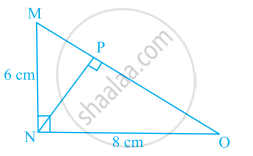
In the following figure, ΔMNO is a right-angled triangle. Its legs are 6 cm and 8 cm long. Length of perpendicular NP on the side MO is ______.
पर्याय
4.8 cm
3.6 cm
2.4 cm
1.2 cm
Advertisements
उत्तर
In the following figure, ΔMNO is a right-angled triangle. Its legs are 6 cm and 8 cm long. Length of perpendicular NP on the side MO is 4.8 cm.
Explanation:
Given, ΔMNO is a right angled triangle.
So, according to Pythagoras theorem,
MO2 = MN2 + NO2
= 62 + 82
= 36 + 64
⇒ MO2 = 100
⇒ MO = `sqrt(100)`
⇒ MO = 10 cm
∴ Area of ΔMNO = `1/2` × Base × Height
⇒ `1/2` × MN × NO = `1/2` × MO × NP
⇒ `1/2` × 6 × 8 = `1/2` × 10 × NP
⇒ NP = `24/5`
⇒ NP = 4.8 cm
APPEARS IN
संबंधित प्रश्न
Find the area of the triangle whose vertices are: (–5, –1), (3, –5), (5, 2)
Find the area of a triangle with vertices at the point given in the following:
(1, 0), (6, 0), (4, 3)
Find the area of a triangle with vertices at the point given in the following:
(2, 7), (1, 1), (10, 8)
Find the area of a triangle with vertices at the point given in the following:
(−2, −3), (3, 2), (−1, −8)
The area of a triangle is 5 sq units. Two of its vertices are (2, 1) and (3, –2). If the third vertex is `(7/2, y)`, find the value of y.
Find the area of the quadrilaterals, the coordinates of whose vertices are
(1, 2), (6, 2), (5, 3) and (3, 4)
If G be the centroid of a triangle ABC and P be any other point in the plane, prove that PA2+ PB2 + PC2 = GA2 + GB2 + GC2 + 3GP2.
If the coordinates of the mid-points of the sides of a triangle are (1, 1), (2, —3) and (3, 4), find the vertices of the triangle.
If the area of triangle ABC formed by A(x, y), B(1, 2) and C(2, 1) is 6 square units, then prove that x + y = 15 ?
If the points A(1, 2), O(0, 0) and C(a, b) are collinear, then ______.
