Advertisements
Advertisements
Question
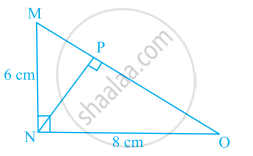
In the following figure, ΔMNO is a right-angled triangle. Its legs are 6 cm and 8 cm long. Length of perpendicular NP on the side MO is ______.
Options
4.8 cm
3.6 cm
2.4 cm
1.2 cm
Advertisements
Solution
In the following figure, ΔMNO is a right-angled triangle. Its legs are 6 cm and 8 cm long. Length of perpendicular NP on the side MO is 4.8 cm.
Explanation:
Given, ΔMNO is a right angled triangle.
So, according to Pythagoras theorem,
MO2 = MN2 + NO2
= 62 + 82
= 36 + 64
⇒ MO2 = 100
⇒ MO = `sqrt(100)`
⇒ MO = 10 cm
∴ Area of ΔMNO = `1/2` × Base × Height
⇒ `1/2` × MN × NO = `1/2` × MO × NP
⇒ `1/2` × 6 × 8 = `1/2` × 10 × NP
⇒ NP = `24/5`
⇒ NP = 4.8 cm
APPEARS IN
RELATED QUESTIONS
Find the values of k for which the points A(k + 1, 2k), B(3k, 2k + 3) and (5k – 1, 5k) are collinear.
Prove that the points (a, b + c), (b, c + a) and (c, a + b) are collinear
Find the area of a triangle with vertices at the point given in the following:
(2, 7), (1, 1), (10, 8)
Find the equation of the line joining (3, 1) and (9, 3) using the determinants.
Find the missing value:
| Base | Height | Area of triangle |
| 15 cm | ______ | 87 cm2 |
Find the area of the quadrilaterals, the coordinates of whose vertices are (–3, 2), (5, 4), (7, –6) and (–5, –4).
If G(–2, 1) is the centroid of a ΔABC and two of its vertices are A(1, –6) and B(–5, 2), find the third vertex of the triangle.
Find the value of x for which the points (x, −1), (2, 1) and (4, 5) are collinear ?
Find the missing value:
| Base | Height | Area of parallelogram |
| ______ | 15 cm | 154.5 cm2 |
Observe all the four triangles FAB, EAB, DAB and CAB as shown in the following figure.

- All triangles have the same base and the same altitude.
- All triangles are congruent.
- All triangles are equal in area.
- All triangles may not have the same perimeter.
