Advertisements
Advertisements
Question
Area of triangle PQR is 100 cm2 (see figure). If altitude QT is 10 cm, then its base PR is ______.

Options
20 cm
15 cm
10 cm
5 cm
Advertisements
Solution
Area of triangle PQR is 100 cm2 (see figure). If altitude QT is 10 cm, then its base PR is 20 cm.
Explanation:
We know that, area of triangle = `1/2` × base × height
From the question, it is given that, area of triangle PQR = 100 cm2
Height of the triangle = 10 cm = altitude
Therefore, area of triangle = `1/2` × base × height
100 = `1/2` × PR × 10
PR = `(100 xx 2)/10`
PR = `200/10`
PR = 20 cm
APPEARS IN
RELATED QUESTIONS
median of a triangle divides it into two triangles of equal areas. Verify this result for ΔABC whose vertices are A (4, - 6), B (3, - 2) and C (5, 2).
The vertices of a ΔABC are A (4, 6), B (1, 5) and C (7, 2). A line is drawn to intersect sides AB and AC at D and E respectively, such that `(AD)/(AB) = (AE)/(AC) = 1/4`Calculate the area of the ΔADE and compare it with the area of ΔABC. (Recall Converse of basic proportionality theorem and Theorem 6.6 related to ratio of areas of two similar triangles)
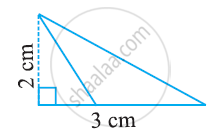
Find the area of the following triangle:
Find the area of triangle whose vertices are `(at_1^2, 2at_1), (at_2^2, 2at_2)` and `(at_3^2, 2at_3)`.
The perimeter of a triangular field is 540 m and its sides are in the ratio 25 : 17 : 12. Find the area of the triangle.
A(7, –3), B(5, 3) and C(3, –1) are the vertices of a ΔABC and AD is its median. Prove that the median AD divides ΔABC into two triangles of equal areas.
For what value of y, are the points P(1, 4), Q(3,y) and R(-3, 16) are collinear ?
Show that ∆ ABC with vertices A (–2, 0), B (0, 2) and C (2, 0) is similar to ∆ DEF with vertices D (–4, 0), F (4, 0) and E (0, 4) ?
The area of a triangle with vertices (a, b + c), (b, c + a) and (c, a + b) is ______.
Using determinants, find the area of ΔPQR with vertices P(3, 1), Q(9, 3) and R(5, 7). Also, find the equation of line PQ using determinants.
