Advertisements
Advertisements
Question
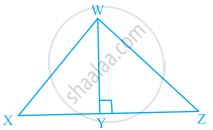
Ratio of the area of ∆WXY to the area of ∆WZY is 3 : 4 (see figure). If the area of ∆WXZ is 56 cm2 and WY = 8 cm, find the lengths of XY and YZ.
Advertisements
Solution
Given, area of ∆WXZ = 56 cm2
⇒ `1/2` × WY × XZ = 56 ...[∵ area of triangle = `1/2` × base × height]
⇒ `1/2` × 8 × XZ = 56 ...[∵ WY = 8 cm, given]
⇒ XZ = 14 cm
∴ Area of ∆WXY : Area of ∆WZY = 3 : 4
⇒ `"Area of ∆WXY"/"Area of ∆WZY" = 3/4`
⇒ `(1/2 xx WY xx XY)/(1/2 xx YZ xx WY) = 3/4`
⇒ `(XY)/(YZ) = 3/4`
⇒ `(XY)/(XZ - XY) = 3/4` ...[∵ YZ = XZ – XY]
⇒ `(XY)/(14 - XY) = 3/4` ...[By cross-multiplication]
⇒ 4XY = 42 – 3XY
⇒ 7XY = 42
⇒ XY = 6 cm
So, YZ = XZ – XY = 14 – 6
YZ = 8 cm
Hence, XY = 6 cm and YZ = 8 cm.
APPEARS IN
RELATED QUESTIONS
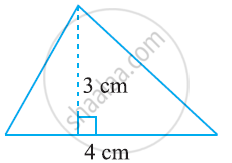
Find the area of the following triangle:
Prove that the points (a, 0), (0, b) and (1, 1) are collinear if `1/a+1/b=1`
Find the area of a triangle whose sides are respectively 150 cm, 120 cm and 200 cm ?
For what value of y, are the points P(1, 4), Q(3,y) and R(-3, 16) are collinear ?
Find the value of y for which the points A(–3, 9), B(2, y) and C(4, –5) are collinear.
What is the area of a triangle with base 4.8 cm and height 3.6 cm?
The table given below contains some measures of the right angled triangle. Find the unknown values.
| Base | Height | Area |
| ? | 12 m | 24 sq.m |
If Δ = `|(1, x, x^2),(1, y, y^2),(1, z, z^2)|`, Δ1 = `|(1, 1, 1),(yz, zx, xy),(x, y, z)|`, then prove that ∆ + ∆1 = 0.
Points A(–6, 10), B(–4, 6) and C(3, –8) are collinear such that AB = `2/9` AC.
Find the coordinates of the point Q on the x-axis which lies on the perpendicular bisector of the line segment joining the points A(–5, –2) and B(4, –2). Name the type of triangle formed by the points Q, A and B.
