Advertisements
Advertisements
प्रश्न
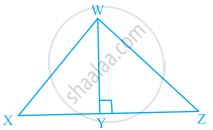
Ratio of the area of ∆WXY to the area of ∆WZY is 3 : 4 (see figure). If the area of ∆WXZ is 56 cm2 and WY = 8 cm, find the lengths of XY and YZ.
Advertisements
उत्तर
Given, area of ∆WXZ = 56 cm2
⇒ `1/2` × WY × XZ = 56 ...[∵ area of triangle = `1/2` × base × height]
⇒ `1/2` × 8 × XZ = 56 ...[∵ WY = 8 cm, given]
⇒ XZ = 14 cm
∴ Area of ∆WXY : Area of ∆WZY = 3 : 4
⇒ `"Area of ∆WXY"/"Area of ∆WZY" = 3/4`
⇒ `(1/2 xx WY xx XY)/(1/2 xx YZ xx WY) = 3/4`
⇒ `(XY)/(YZ) = 3/4`
⇒ `(XY)/(XZ - XY) = 3/4` ...[∵ YZ = XZ – XY]
⇒ `(XY)/(14 - XY) = 3/4` ...[By cross-multiplication]
⇒ 4XY = 42 – 3XY
⇒ 7XY = 42
⇒ XY = 6 cm
So, YZ = XZ – XY = 14 – 6
YZ = 8 cm
Hence, XY = 6 cm and YZ = 8 cm.
APPEARS IN
संबंधित प्रश्न
Find the relation between x and y if, the points A(x, y), B(-5, 7) and C(-4, 5) are collinear.
If P(–5, –3), Q(–4, –6), R(2, –3) and S(1, 2) are the vertices of a quadrilateral PQRS, find its area.
Show that points A(a, b + c), B(b, c + a), C(c, a + b) are collinear.
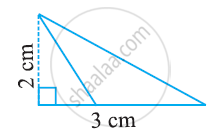
Find the area of the following triangle:
Find the area of triangle whose vertices are `(at_1^2, 2at_1), (at_2^2, 2at_2)` and `(at_3^2, 2at_3)`.
Find the area of triangle whose vertices are (a, c + a), (a, c) and (–a, c – a).
Find the value(s) of k so that the quadratic equation x2 − 4kx + k = 0 has equal roots.
If A, B, C are the angles of a triangle, then ∆ = `|(sin^2"A", cot"A", 1),(sin^2"B", cot"B", 1),(sin^2"C", cot"C", 1)|` = ______.
Ratio of areas of ∆MNO, ∆MOP and ∆MPQ in the following figure is ______.

Find the missing value:
| Base | Height | Area of Triangle |
| 22 cm | ______ | 170.5 cm2 |
