Advertisements
Advertisements
प्रश्न
Find the missing value:
| Base | Height | Area of Triangle |
| ______ | 31.4 mm | 1256 mm2 |
Advertisements
उत्तर
| Base | Height | Area of Triangle |
| 80 | 31.4 mm | 1256 mm2 |
Explanation:
b = ?
h = 31.4 mm
Area = `1/2 xx b xx h` = 1256 mm2
`1/2 xx b xx 3.14` = 1256
b = `(1256xx2)/31.4`
b = 80 mm
Therefore, the base of triangle is 80 mm.
संबंधित प्रश्न
The vertices of ∆ABC = are A (4, 6), B(1, 5) and C(7, 2). A line is drawn to intersect sides AB and AC at D and E respectively such that `\frac{AD}{AB}=\frac{AE}{AC}=\frac{1}{4}` .Calculate the area of ∆ADE and compare it with the area of ∆ABC
Find the area of triangle whose vertices are `(at_1^2, 2at_1), (at_2^2, 2at_2)` and `(at_3^2, 2at_3)`.
The area of a triangle is 5. Two of its vertices are (2, 1) and (3, –2). The third vertex lies on y = x + 3. Find the third vertex.
In a ΔABC, AB = 15 cm, BC = 13 cm and AC = 14 cm. Find the area of ΔABC and hence its altitude on AC ?
Find the centroid of ΔABC whose vertices are A(–1, 0), B(5, –2) and C(8, 2).
Find the value of p for which the points (−5, 1), (1, p) and (4, −2) are collinear.
Using integration, find the area of triangle ABC, whose vertices are A(2, 5), B(4, 7) and C(6, 2).
The area of a triangle with vertices (a, b + c), (b, c + a) and (c, a + b) is ______.
Find the area of the triangle whose vertices are (–8, 4), (–6, 6) and (–3, 9).
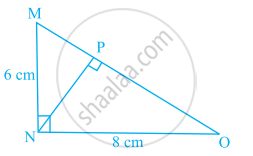
In the following figure, ΔMNO is a right-angled triangle. Its legs are 6 cm and 8 cm long. Length of perpendicular NP on the side MO is ______.