Advertisements
Advertisements
प्रश्न
Find the missing value:
| Base | Height | Area of Triangle |
| 22 cm | ______ | 170.5 cm2 |
Advertisements
उत्तर
| Base | Height | Area of Triangle |
| 22 cm | 15.5 | 170.5 cm2 |
Explanation:
b = 22 cm
h = ?
Area = `1/2 xx b xx h` = 170.5 cm2
`1/2 xx 22 xx h` = 170.5 cm2
h = `(170.5 xx 2)/22`
h = 15.5 cm
Therefore, the height of such triangle is 15.5 cm.
संबंधित प्रश्न
Find the area of a triangle with vertices at the point given in the following:
(1, 0), (6, 0), (4, 3)
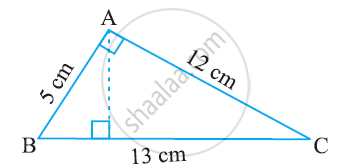
ΔABC is right angled at A (see the given figure). AD is perpendicular to BC. If AB = 5 cm, BC = 13 cm and AC = 12 cm, Find the area of ΔABC. Also find the length of AD.
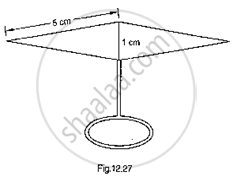
Find the area of the blades of thc magnetic compass shown in Fig.. 12.27. (Take √11 = 3.32).
A(6, 1), B(8, 2) and C(9, 4) are the vertices of a parallelogram ABCD. If E is the midpoint of DC, find the area of ΔADE.
Find the value of k so that the area of the triangle with vertices A(k + 1, 1), B(4, –3) and C(7, –k) is 6 square units.
Show that the following points are collinear:
A(2, –2), B(–3, 8) and C(–1, 4)
The value of the determinant `abs((1,"x","x"^3),(1,"y","y"^3),(1,"z","z"^3))` is ____________.
The points A(2, 9), B(a, 5) and C(5, 5) are the vertices of a triangle ABC right angled at B. Find the values of a and hence the area of ∆ABC.
Find the values of k if the points A(k + 1, 2k), B(3k, 2k + 3) and C(5k – 1, 5k) are collinear.
Find the cost of laying grass in a triangular field of sides 50 m, 65 m and 65 m at the rate of Rs 7 per m2.
