Advertisements
Advertisements
प्रश्न
The table given below contains some measures of the right angled triangle. Find the unknown values.
| Base | Height | Area |
| 20 cm | 40 cm | ? |
Advertisements
उत्तर
Area of the right triangle = `1/2 xx ("base" xx "height") "unit"^2`
b = 20 cm
h = 40 cm
Area = `1/2 ("b" xx "h") "cm"^2`
= `1/2 xx 20 xx 40`
= 400 cm2
A = 400 cm2
Tabulating the unknown values
| Base | Height | Area |
| 20 cm | 40 cm | 400 cm2 |
APPEARS IN
संबंधित प्रश्न
Find the area of a triangle whose vertices are A(3, 2), B (11, 8) and C(8, 12).
Find the centre of a circle passing through the points (6, − 6), (3, − 7) and (3, 3).
Find the area of the following triangle:
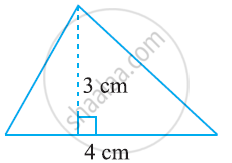
Find the area of the following triangle:

Find the area of the following triangle:
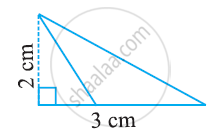
Show that the following sets of points are collinear.
(2, 5), (4, 6) and (8, 8)
Find the area of ΔABC with vertices A(0, –1), B(2, 1) and C(0, 3). Also, find the area of the triangle formed by joining the midpoints of its sides. Show that the ratio of the areas of two triangles is 4 : 1.
The area of a triangle with vertices (–3, 0), (3, 0) and (0, k) is 9 sq.units. The value of k will be ______.
Ratio of the area of ∆WXY to the area of ∆WZY is 3 : 4 (see figure). If the area of ∆WXZ is 56 cm2 and WY = 8 cm, find the lengths of XY and YZ.
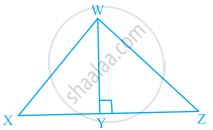
Using determinants, find the area of ΔPQR with vertices P(3, 1), Q(9, 3) and R(5, 7). Also, find the equation of line PQ using determinants.
