Advertisements
Advertisements
प्रश्न
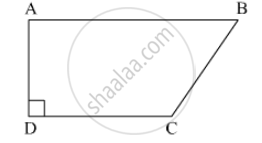
In ☐ABCD, l(AB) = 13 cm, l(DC) = 9 cm, l(AD) = 8 cm, find the area of ☐ABCD.
Advertisements
उत्तर
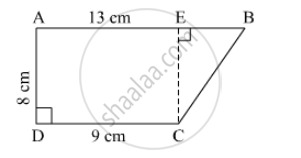
Draw perpendicular from C to line AB. Name the point E.
CE = AD = 8 cm
EB = AB − AE = AB − CD = 13 − 9 = 4cm
∴ Area of of a trapezium = `1/2 xx "sum of lengths of parallel sides" xx h`
A (☐ABCD) = `1/2 xx [l(AB) + l(DC)] xx l(AD)`
= `1/2 xx (13 + 9) xx 8`
= `1/2 xx 22 xx 8`
= 11 x 8
= 88 sq. cm
∴ The area of ☐ABCD is 88 sq. cm.
संबंधित प्रश्न
Find the area of the triangle ABC with A(1, −4) and mid-points of sides through A being (2, −1) and (0, −1).
Find the area of a triangle with vertices at the point given in the following:
(1, 0), (6, 0), (4, 3)
Prove that the points (2a, 4a), (2a, 6a) and `(2a + sqrt3a, 5a)` are the vertices of an equilateral triangle.
The point A divides the join of P (–5, 1) and Q (3, 5) in the ratio k : 1. Find the two values of k for which the area of ΔABC where B is (1, 5) and C (7, –2) is equal to 2 units.
For what value of a the point (a, 1), (1, –1) and (11, 4) are collinear?
Using integration, find the area of triangle ABC, whose vertices are A(2, 5), B(4, 7) and C(6, 2).
The table given below contains some measures of the right angled triangle. Find the unknown values.
| Base | Height | Area |
| 20 cm | 40 cm | ? |
The points (0, 5), (0, –9) and (3, 6) are collinear.
Points A(–6, 10), B(–4, 6) and C(3, –8) are collinear such that AB = `2/9` AC.
The area of a triangle with base 4 cm and height 6 cm is 24 cm2.
