Advertisements
Advertisements
Question
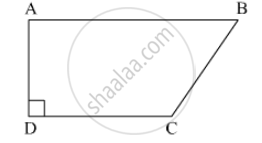
In ☐ABCD, l(AB) = 13 cm, l(DC) = 9 cm, l(AD) = 8 cm, find the area of ☐ABCD.
Advertisements
Solution
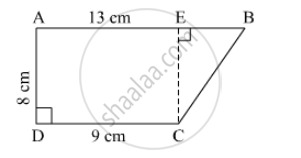
Draw perpendicular from C to line AB. Name the point E.
CE = AD = 8 cm
EB = AB − AE = AB − CD = 13 − 9 = 4cm
∴ Area of of a trapezium = `1/2 xx "sum of lengths of parallel sides" xx h`
A (☐ABCD) = `1/2 xx [l(AB) + l(DC)] xx l(AD)`
= `1/2 xx (13 + 9) xx 8`
= `1/2 xx 22 xx 8`
= 11 x 8
= 88 sq. cm
∴ The area of ☐ABCD is 88 sq. cm.
RELATED QUESTIONS
Find the area of the triangle ABC with A(1, −4) and mid-points of sides through A being (2, −1) and (0, −1).
If A(4, –6), B(3, –2) and C(5, 2) are the vertices of ∆ABC, then verify the fact that a median of a triangle ABC divides it into two triangle of equal areas.
In each of the following find the value of 'k', for which the points are collinear.
(7, -2), (5, 1), (3, -k)
In a ΔABC, AB = 15 cm, BC = 13 cm and AC = 14 cm. Find the area of ΔABC and hence its altitude on AC ?
Find the third vertex of a ΔABC if two of its vertices are B(–3, 1) and C(0, –2) and its centroid is at the origin.
Find the area of ΔABC whose vertices are A(1, 2) B(–2, 3) and C(–3, –4).
If the co-ordinates of the vertices of an equilateral triangle with sides of length ‘a’ are (x1, y1), (x2, y2), (x3, y3), then `|(x_1, y_1, 1),(x_2, y_2, 1),(x_3, y_3, 1)|^2 = (3"a"^4)/4`
Find the values of k if the points A(k + 1, 2k), B(3k, 2k + 3) and C(5k – 1, 5k) are collinear.
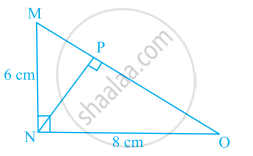
In the following figure, ΔMNO is a right-angled triangle. Its legs are 6 cm and 8 cm long. Length of perpendicular NP on the side MO is ______.
Using determinants, find the area of ΔPQR with vertices P(3, 1), Q(9, 3) and R(5, 7). Also, find the equation of line PQ using determinants.
