Advertisements
Advertisements
Question
If length of a diagonal of a rhombus is 30 cm and its area is 240 sq cm, find its perimeter.
Advertisements
Solution
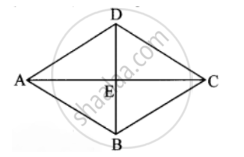
Let ABCD be the rhombus.
Diagonals AC and BD intersect at point E.
l(AC) = 30 cm …(i)
and Area of a rhombus = 240 sq. cm …(ii)
Area of a rhombus = `1/2` (product of diagnols)
⇒ 240 = `1/2` × (30 × DB)
⇒ DB = `(240 xx 2)/30` = 16 …(iii)
Diagonals of a rhombus bisect each other.
∴ `l(AE) = 1/2 l(AC)`
= `1/2 xx 30`
= 15 cm …(iv)
∴ `l(DE) = 1/2 l(DB)`
= `1/2 xx 16`
= 8 cm …(v)
In ΔADE,
∠AED = 90° …[Diagonals of a rhombus are perpendicular to each other]
AE2 + DE2 = AD2 …[Pythagoras theorem]
⇒ 152 + 82 = AD2 ...[From (iv) and (v)]
⇒ AD2 = 225 + 64 = 289
⇒ AD = `sqrt289` …[Taking square root of both sides]
= 17 cm
Thus, the side of the rhombus = 17 cm
Perimeter of rhombus = 4 × side
= `4 xx 17`
= 68 cm
∴ The perimeter of the rhombus is 68 cm.
RELATED QUESTIONS
Find the area of a rhombus whose diagonals are of lengths 10 cm and 8.2 cm.
Find the area of rhombus PQRS shown in the following figure.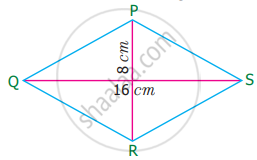
The area of a rhombus is 100 sq.cm and length of one of its diagonals is 8 cm. Find the length of the other diagonal
A sweet is in the shape of rhombus whose diagonals are given as 4 cm and 5 cm. The surface of the sweet should be covered by an aluminum foil. Find the cost of aluminum foil used for 400 such sweets at the rate of ₹ 7 per 100 sq.cm
The area of the rhombus with side 4 cm and height 3 cm is
The area of the rhombus when both diagonals measuring 8 cm is
The angle between the diagonals of a rhombus is
The figure ABCD is a quadrilateral in which AB = CD and BC = AD. Its area is ______.
The area of a rectangular field is 48 m2 and one of its sides is 6 m. How long will a lady take to cross the field diagonally at the rate of 20 m/minute?
Most of the sailboats have two sails, the jib and the mainsail. Assume that the sails are triangles. Find the total area sail of the sailboats to the nearest tenth.