Advertisements
Advertisements
Question
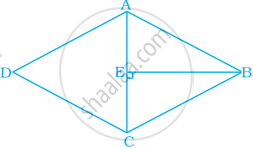
What is the area of the rhombus ABCD below if AC = 6 cm and BE = 4 cm?
Options
36 cm2
16 cm2
24 cm2
13 cm2
Advertisements
Solution
24 cm2
Explanation:
The diagonal AC of the rhombus ABCD divides it into two triangles of equal areas.
Now, area of ΔABC = `1/2` × Base × Height
= `1/2 xx 4 xx 6`
= 12 cm2
∴ Area of the rhombus ABCD = 2 × Area of ΔABC
= 2 × 12
= 24 cm2
APPEARS IN
RELATED QUESTIONS
A thin metal iron-sheet is rhombus in shape, with each side 10 m. If one of its diagonals is 16 m, find the cost of painting both sides at the rate of ₹ 6 per m2. Also, find the distance between the opposite sides of this rhombus.
Find the area of a rhombus whose base is 14 cm and height is 9 cm.
Find the missing value.
| Diagonal (d1) | Diagonal (d2) | Area |
| 26 m | 468 sq.m |
The area of the rhombus is 128 sq.cm and the length of one diagonal is 32 cm. The length of the other diagonal is
The area of the rhombus is 576 sq.cm and the length of one of its diagonal is half of the length of the other diagonal then find the length of the diagonal
One of the diagonals of a rhombus is thrice as the other. If the sum of the length of the diagonals is 24 cm, then find the area of the rhombus.
Area of a rhombus = `1/2` product of ______.
The area of a rectangular field is 48 m2 and one of its sides is 6 m. How long will a lady take to cross the field diagonally at the rate of 20 m/minute?
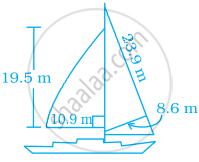
Most of the sailboats have two sails, the jib and the mainsail. Assume that the sails are triangles. Find the total area sail of the sailboats to the nearest tenth.