Advertisements
Advertisements
Question
If the diagonals of a rhombus get doubled, then the area of the rhombus becomes ______ its original area.
Advertisements
Solution
If the diagonals of a rhombus get doubled, then the area of the rhombus becomes 4 times its original area.
Explanation:
We know that,
Area of a rhombus = `1/2 xx d_1 xx d_2`
Where, d1 and d2 are diagonals of the rhombus.
If diagonals get doubled, then the area = `1/2 2d_1 xx 2d_2 = 4(1/2 xx d_1 xx d_2)`
Hence, the new area becomes 4 times its original area.
APPEARS IN
RELATED QUESTIONS
Lengths of the diagonals of a rhombus are 15 cm and 24 cm, find its area.
Lengths of the diagonals of a rhombus are 16.5 cm and 14.2 cm, find its area.
If length of a diagonal of a rhombus is 30 cm and its area is 240 sq cm, find its perimeter.
Each side of a rhombus is 18 cm. If the distance between two parallel sides is 12 cm, find its area.
The length of the diagonals of a rhombus is in ratio 4 : 3. If its area is 384 cm2, find its side.
Find the area of a rhombus whose base is 14 cm and height is 9 cm.
The area of the rhombus when both diagonals measuring 8 cm is
The area of the rhombus is 576 sq.cm and the length of one of its diagonal is half of the length of the other diagonal then find the length of the diagonal
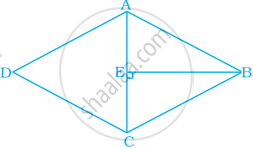
What is the area of the rhombus ABCD below if AC = 6 cm and BE = 4 cm?
Area of a rhombus = `1/2` product of ______.
