Advertisements
Advertisements
प्रश्न
If the diagonals of a rhombus get doubled, then the area of the rhombus becomes ______ its original area.
Advertisements
उत्तर
If the diagonals of a rhombus get doubled, then the area of the rhombus becomes 4 times its original area.
Explanation:
We know that,
Area of a rhombus = `1/2 xx d_1 xx d_2`
Where, d1 and d2 are diagonals of the rhombus.
If diagonals get doubled, then the area = `1/2 2d_1 xx 2d_2 = 4(1/2 xx d_1 xx d_2)`
Hence, the new area becomes 4 times its original area.
APPEARS IN
संबंधित प्रश्न
Lengths of the diagonals of a rhombus are 15 cm and 24 cm, find its area.
If perimeter of a rhombus is 100 cm and length of one diagonal is 48 cm, what is the area of the quadrilateral?
Find the area of rhombus PQRS shown in the following figure.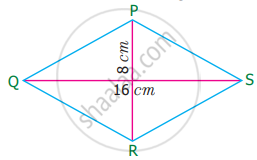
Find the area of a rhombus whose base is 14 cm and height is 9 cm.
The area of the rhombus when both diagonals measuring 8 cm is
The height of the rhombus whose area 96 sq.m and side 24 m is
The area of the rhombus is 576 sq.cm and the length of one of its diagonal is half of the length of the other diagonal then find the length of the diagonal
A man has to build a rhombus shaped swimming pool. One of the diagonal is 13 m and the other is twice the first one. Then find the area of the swimming pool and also find the cost of cementing the floor at the rate of ₹ 15 per sq.cm
What is the area of the rhombus ABCD below if AC = 6 cm and BE = 4 cm?
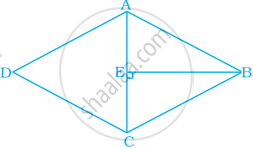
Area of a rhombus = `1/2` product of ______.
