Advertisements
Advertisements
प्रश्न
What is the area of the rhombus ABCD below if AC = 6 cm and BE = 4 cm?
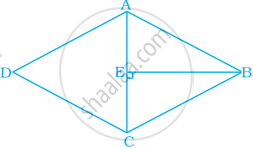
पर्याय
36 cm2
16 cm2
24 cm2
13 cm2
Advertisements
उत्तर
24 cm2
Explanation:
The diagonal AC of the rhombus ABCD divides it into two triangles of equal areas.
Now, area of ΔABC = `1/2` × Base × Height
= `1/2 xx 4 xx 6`
= 12 cm2
∴ Area of the rhombus ABCD = 2 × Area of ΔABC
= 2 × 12
= 24 cm2
APPEARS IN
संबंधित प्रश्न
Lengths of the diagonals of a rhombus are 16.5 cm and 14.2 cm, find its area.
If length of a diagonal of a rhombus is 30 cm and its area is 240 sq cm, find its perimeter.
A thin metal iron-sheet is rhombus in shape, with each side 10 m. If one of its diagonals is 16 m, find the cost of painting both sides at the rate of ₹ 6 per m2. Also, find the distance between the opposite sides of this rhombus.
Find the area of a rhombus whose base is 14 cm and height is 9 cm.
Find the missing value.
| Diagonal (d1) | Diagonal (d2) | Area |
| 26 m | 468 sq.m |
The area of a rhombus is 100 sq.cm and length of one of its diagonals is 8 cm. Find the length of the other diagonal
The height of the rhombus whose area 96 sq.m and side 24 m is
The angle between the diagonals of a rhombus is
The area of the rhombus is 576 sq.cm and the length of one of its diagonal is half of the length of the other diagonal then find the length of the diagonal
Area of a rhombus = `1/2` product of ______.
