Advertisements
Advertisements
प्रश्न
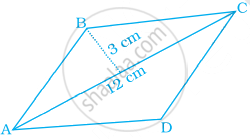
The figure ABCD is a quadrilateral in which AB = CD and BC = AD. Its area is ______.
पर्याय
72 cm2
36 cm2
24 cm2
18 cm2
Advertisements
उत्तर
The figure ABCD is a quadrilateral in which AB = CD and BC = AD. Its area is 36 cm2.
Explanation:
It is clear from the figure that, quadrilateral ABCD is a parallelogram. The diagonal AC of the given parallelogram ABCD divides it into two triangles of equal areas.
Area of the ΔABC = `1/2 xx "Base" xx "Height"`
= `1/2 xx 12 xx 3`
= 18 cm2
∴ Area of parallelogram ABCD = 2 × Area of ΔABC
= 2 × 18
= 36 cm2
APPEARS IN
संबंधित प्रश्न
If perimeter of a rhombus is 100 cm and length of one diagonal is 48 cm, what is the area of the quadrilateral?
The length of the diagonals of a rhombus is in ratio 4 : 3. If its area is 384 cm2, find its side.
Find the missing value.
| Diagonal (d1) | Diagonal (d2) | Area |
| 19 cm | 16 cm |
The area of a rhombus is 100 sq.cm and length of one of its diagonals is 8 cm. Find the length of the other diagonal
The area of the rhombus is 128 sq.cm and the length of one diagonal is 32 cm. The length of the other diagonal is
The angle between the diagonals of a rhombus is
If the diagonals of a rhombus get doubled, then the area of the rhombus becomes ______ its original area.
Area of a rhombus = `1/2` product of ______.
The walls and ceiling of a room are to be plastered. The length, breadth and height of the room are 4.5 m, 3 m, and 350 cm respectively. Find the cost of plastering at the rate of Rs 8 per m2.
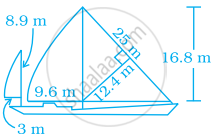
Most of the sailboats have two sails, the jib and the mainsail. Assume that the sails are triangles. Find the total area of sail of the sailboats to the nearest tenth.