Advertisements
Advertisements
प्रश्न
The length of the diagonals of a rhombus is in ratio 4 : 3. If its area is 384 cm2, find its side.
Advertisements
उत्तर
Let the lengths of the diagonals of a rhombus are 4x, 3x.
∴ Area of the rhombus = `1/2 xx ("Product of its diagonals")`
= `1/2 (4x xx 3x) = 384` (given)
⇒ `6x^2 = 384 ⇒ x^2 = 64`
⇒ x = 8 cm
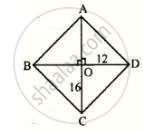
∴ Diagonals are `4 xx 8 = 32` cm and `3(8) = 24` cm.
∴ OC = 16 cm and OD = 12 cm
∴ Side DC = `sqrt("OC"^2 + "OD"^2)`
∴ Side DC = `sqrt(16^2 + 12^2)` [By Pythagoras Theorem in ΔDOC]
= `sqrt(256 + 144) = sqrt(400) = 20` cm
Hence , side of the rhombus = 20 cm.
APPEARS IN
संबंधित प्रश्न
If perimeter of a rhombus is 100 cm and length of one diagonal is 48 cm, what is the area of the quadrilateral?
The diagonals of a rhombus are 18 cm and 24 cm. Find:
(i) its area ;
(ii) length of its sides.
(iii) its perimeter
The area of a rhombus is equal to the area of a triangle. If the base ∆ is 24 cm, its corresponding altitude is 16 cm and one of the diagonals of the rhombus is 19.2 cm. Find its other diagonal.
Find the missing value.
| Diagonal (d1) | Diagonal (d2) | Area |
| 19 cm | 16 cm |
The area of the rhombus when both diagonals measuring 8 cm is
If the diagonals of a rhombus get doubled, then the area of the rhombus becomes ______ its original area.
The area of a rectangular field is 48 m2 and one of its sides is 6 m. How long will a lady take to cross the field diagonally at the rate of 20 m/minute?
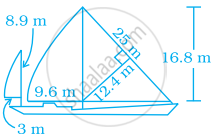
Most of the sailboats have two sails, the jib and the mainsail. Assume that the sails are triangles. Find the total area sail of the sailboats to the nearest tenth.
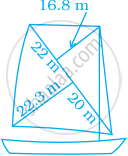
Most of the sailboats have two sails, the jib and the mainsail. Assume that the sails are triangles. Find the total area of sail of the sailboats to the nearest tenth.