Advertisements
Advertisements
प्रश्न
The area of the rhombus is 576 sq.cm and the length of one of its diagonal is half of the length of the other diagonal then find the length of the diagonal
Advertisements
उत्तर
Let one diagonal of the rhombus = d2 cm
The other diagonal d2 = `1/2` × d1 cm
Area of the rhombus = 576 sq.cm
`1/2` × (d1 × d2) = 576
`1/2` × (d1 × `1/2` d1) = 576
d1 × d1 = 576 × 2 × 2
= 6 × 6 × 4 × 4 × 2 × 2
d1 × d1 = 6 × 4 × 2 × 6 × 4 × 2
d1 = 6 × 4 × 2
d1 = 48 cm
d2 = `1/2` × 48 = 24 cm
∴ Length of the diagonals d1 = 48 cm and d2 = 24 cm.
APPEARS IN
संबंधित प्रश्न
Lengths of the diagonals of a rhombus are 16.5 cm and 14.2 cm, find its area.
If perimeter of a rhombus is 100 cm and length of one diagonal is 48 cm, what is the area of the quadrilateral?
The diagonals of a rhombus are 18 cm and 24 cm. Find:
(i) its area ;
(ii) length of its sides.
(iii) its perimeter
A thin metal iron-sheet is rhombus in shape, with each side 10 m. If one of its diagonals is 16 m, find the cost of painting both sides at the rate of ₹ 6 per m2. Also, find the distance between the opposite sides of this rhombus.
Find the area of rhombus PQRS shown in the following figure.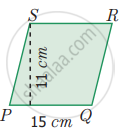
Find the area of a rhombus whose base is 14 cm and height is 9 cm.
Find the missing value.
| Diagonal (d1) | Diagonal (d2) | Area |
| 26 m | 468 sq.m |
Find the missing value.
| Diagonal (d1) | Diagonal (d2) | Area |
| 12 mm | 180 sq.mm |
The area of a rhombus is 100 sq.cm and length of one of its diagonals is 8 cm. Find the length of the other diagonal
The angle between the diagonals of a rhombus is
