Advertisements
Advertisements
प्रश्न
Find the missing value.
| Diagonal (d1) | Diagonal (d2) | Area |
| 19 cm | 16 cm |
Advertisements
उत्तर
Given diagonal d1 = 19 cm, d2 = 16 cm
Area of the rhombus = `1/2` (d1 × d2) sq.units
= `1/2` × 19 × 16
= 152 cm2
Tabulating the results we have
| Diagonal (d1) | Diagonal (d2) | Area |
| 19 cm | 16 cm | 152 sq.cm |
APPEARS IN
संबंधित प्रश्न
Lengths of the diagonals of a rhombus are 15 cm and 24 cm, find its area.
If length of a diagonal of a rhombus is 30 cm and its area is 240 sq cm, find its perimeter.
The diagonals of a rhombus are 18 cm and 24 cm. Find:
(i) its area ;
(ii) length of its sides.
(iii) its perimeter
Find the area of a rhombus whose diagonals are of lengths 10 cm and 8.2 cm.
Find the missing value.
| Diagonal (d1) | Diagonal (d2) | Area |
| 26 m | 468 sq.m |
The area of a rhombus is 100 sq.cm and length of one of its diagonals is 8 cm. Find the length of the other diagonal
The area of the rhombus with side 4 cm and height 3 cm is
A man has to build a rhombus shaped swimming pool. One of the diagonal is 13 m and the other is twice the first one. Then find the area of the swimming pool and also find the cost of cementing the floor at the rate of ₹ 15 per sq.cm
Area of a rhombus = `1/2` product of ______.
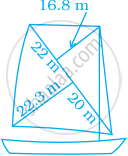
Most of the sailboats have two sails, the jib and the mainsail. Assume that the sails are triangles. Find the total area sail of the sailboats to the nearest tenth.