Advertisements
Advertisements
प्रश्न
Find the missing value.
| Diagonal (d1) | Diagonal (d2) | Area |
| 19 cm | 16 cm |
Advertisements
उत्तर
Given diagonal d1 = 19 cm, d2 = 16 cm
Area of the rhombus = `1/2` (d1 × d2) sq.units
= `1/2` × 19 × 16
= 152 cm2
Tabulating the results we have
| Diagonal (d1) | Diagonal (d2) | Area |
| 19 cm | 16 cm | 152 sq.cm |
APPEARS IN
संबंधित प्रश्न
Lengths of the diagonals of a rhombus are 16.5 cm and 14.2 cm, find its area.
If length of a diagonal of a rhombus is 30 cm and its area is 240 sq cm, find its perimeter.
The length of the diagonals of a rhombus is in ratio 4 : 3. If its area is 384 cm2, find its side.
The area of the rhombus with side 4 cm and height 3 cm is
The area of the rhombus when both diagonals measuring 8 cm is
The height of the rhombus whose area 96 sq.m and side 24 m is
The angle between the diagonals of a rhombus is
What is the area of the rhombus ABCD below if AC = 6 cm and BE = 4 cm?
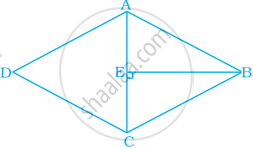
Area of a rhombus = `1/2` product of ______.
The walls and ceiling of a room are to be plastered. The length, breadth and height of the room are 4.5 m, 3 m, and 350 cm respectively. Find the cost of plastering at the rate of Rs 8 per m2.
