Advertisements
Advertisements
प्रश्न
The area of a rhombus is 100 sq.cm and length of one of its diagonals is 8 cm. Find the length of the other diagonal
Advertisements
उत्तर
Given the length of one diagonal d1 = 8 cm
Area of the rhombus = 100 sq.cm
`1/2` (d1 × d2) = 100
`1/2 xx 8 xx "d"_2` = 100
8 × d2 = 100 × 2
d2 = `(100 xx 2)/8`
= 25 cm
Length of the other diagonal d2 = 25 cm
APPEARS IN
संबंधित प्रश्न
Lengths of the diagonals of a rhombus are 15 cm and 24 cm, find its area.
If perimeter of a rhombus is 100 cm and length of one diagonal is 48 cm, what is the area of the quadrilateral?
Find the area of a rhombus whose diagonals are of lengths 10 cm and 8.2 cm.
Find the area of a rhombus whose base is 14 cm and height is 9 cm.
A sweet is in the shape of rhombus whose diagonals are given as 4 cm and 5 cm. The surface of the sweet should be covered by an aluminum foil. Find the cost of aluminum foil used for 400 such sweets at the rate of ₹ 7 per 100 sq.cm
The angle between the diagonals of a rhombus is
A man has to build a rhombus shaped swimming pool. One of the diagonal is 13 m and the other is twice the first one. Then find the area of the swimming pool and also find the cost of cementing the floor at the rate of ₹ 15 per sq.cm
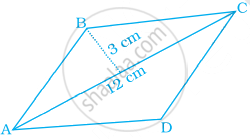
The figure ABCD is a quadrilateral in which AB = CD and BC = AD. Its area is ______.
Most of the sailboats have two sails, the jib and the mainsail. Assume that the sails are triangles. Find the total area of sail of the sailboats to the nearest tenth.