Advertisements
Advertisements
प्रश्न
One of the diagonals of a rhombus is thrice as the other. If the sum of the length of the diagonals is 24 cm, then find the area of the rhombus.
Advertisements
उत्तर
Let one of the diagonals of rhombus be ‘d1’ cm and the other be d2 cm.
Give d1 = 3 × d2
Also d1 + d2 = 24 cm
⇒ 3d2 + d2 = 24
4d2 = 24
d2 = `24/4`
d2 = 6 cm
d1 = 3 × d2 = 3 × 6
d1 = 18 cm
∴ Area of the rhombus = `1/2` × d1 × d2 sq.units
= `1/2` × 18 × 6 cm2
= 54 cm2
Area of the rhombus = 54 cm2
APPEARS IN
संबंधित प्रश्न
Lengths of the diagonals of a rhombus are 15 cm and 24 cm, find its area.
If length of a diagonal of a rhombus is 30 cm and its area is 240 sq cm, find its perimeter.
Each side of a rhombus is 18 cm. If the distance between two parallel sides is 12 cm, find its area.
Find the area of rhombus PQRS shown in the following figure.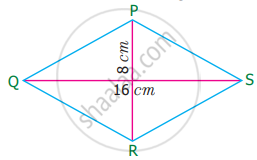
Find the area of rhombus PQRS shown in the following figure.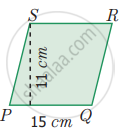
Find the area of a rhombus whose base is 14 cm and height is 9 cm.
Find the missing value.
| Diagonal (d1) | Diagonal (d2) | Area |
| 26 m | 468 sq.m |
The height of the rhombus whose area 96 sq.m and side 24 m is
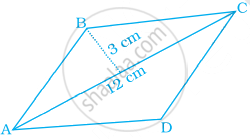
The figure ABCD is a quadrilateral in which AB = CD and BC = AD. Its area is ______.